
Key takeaways
- Content marketing as a discipline is the same as it's always been: earn trust, answer the question before the sale, show up consistently. What's changed is the tooling that produces and distributes it.
- 95% of B2B marketers now use AI somewhere in their workflow, but only 39% say it's actually improving performance. Adoption solved a tooling problem, not a strategy problem.
- The real shift is buyer behavior. 89% now use generative AI for self-guided research, and most evaluation happens before a rep is ever involved.
- Top-of-funnel content now has two audiences: the human reader, and the AI system deciding whether to cite you. Bottom-of-funnel content has one job AI is genuinely good at: removing the friction between "interested" and "convinced."
- A framework that ships is architecture, not a content calendar. A hub, a cluster, and a small number of asset types, each doing one job at one funnel stage.
The discipline hasn't changed. The tooling has.
Most of what gets published about "AI and content marketing" implies the job has changed. It hasn't.
Content marketing still means answering the question a buyer has before they know to ask you directly. It means doing that consistently enough that trust compounds. It means building an asset that keeps working after you stop actively promoting it. None of that is new.
The adoption number that should worry you more than excite you
Here's the single most useful data point in B2B marketing right now. Content Marketing Institute's 2026 B2B research, fielded with MarketingProfs, found that 95% of B2B marketers say their organization uses AI applications somewhere in the workflow.
Only 39% say it's actually improving performance (CMI, via MarketScale, July 2026).
Broken down further: among marketers using AI specifically to generate content, 87% report better productivity and 80% cite operational efficiency. But only 58% see improved content quality, and just 39% see better content performance (The B2B Content Show, July 2026).
AI solved production. It didn't solve strategy.
Where B2B marketers using AI report real gains, and where they don't.
Content Marketing Institute 2026, via MarketScale and The B2B Content Show
Read that stack of numbers in order and the story is obvious. AI is very good at making the same work happen faster. It is not, on its own, making the work better.
The honeymoon is also souring fast. S&P Global Market Intelligence surveyed more than 1,000 enterprises across North America and Europe and found that 42% had abandoned most of their generative AI initiatives in 2025, up from just 17% the year before (CIO Dive, reporting S&P Global Market Intelligence).
How fast the honeymoon ended
Share of companies that abandoned most of their generative AI initiatives.
S&P Global Market Intelligence, reported by CIO Dive
None of this means AI doesn't matter. CMI's data shows AI tools are the single largest area of planned 2026 investment increase, ahead of events and owned media (CMI, 2026).
It means the tooling shift is real, and the strategy vacuum underneath it is also real. Most teams have adopted the capability without changing the framework the capability sits inside. That's the actual opportunity: not "use AI," but rebuild the framework so the capability has somewhere useful to go.
What actually changed: not the content, the buyer's path to it
The tooling shift is the visible change. The buyer behaviour shift is the one that should actually be driving strategy, and it's less talked about.
Forrester's research puts generative AI adoption among B2B buyers at 89% for self-guided research (Forrester, cited via Apollo).
Gartner's most recent buyer survey found 45% of B2B buyers used AI during a recent purchase, weighing an average of seven separate information sources before deciding. 69% still turn to a salesperson afterward, specifically to validate what the AI already told them, not to learn something new (Gartner, cited via Salesprep).
McKinsey's B2B Pulse survey found the number of channels a B2B buyer touches during a purchase has roughly doubled in a decade, from about 5 in 2016 to 10.2 today. More than half would switch suppliers over a poor cross-channel experience (McKinsey, B2B Pulse Survey 2024).
The buyer arrives informed. They don't arrive patient.
How far a B2B buyer gets on their own before a rep is genuinely needed.
No salesperson required to close the deal.
For position-one results, specifically.
Forrester, Gartner and Ahrefs, as cited throughout this guide
Put those together and the picture is a buyer who arrives informed, weighs it against a rep in a single validating conversation, and has almost no patience for a channel that makes them repeat themselves.
Forrester's State of Business Buying research adds a harder number behind that patience problem. 86% of B2B purchases stall somewhere in the process, and 81% of buyers report dissatisfaction with the vendor they eventually chose (Forrester, December 2024, cited via Omnibound).
That's not a demand problem. It's a friction problem. Removing the friction between a buyer who's already 60-plus percent through their own research and the point where talking to a human makes sense is the actual job content marketing has in 2026.
That reframes the AI question usefully. The question isn't whether content should be AI-generated. It's where in this now-longer, now-more-self-directed path AI genuinely removes friction, and where it's just producing more pages nobody asked for.
Top of funnel: the audience is now the reader and the AI system deciding whether to cite you
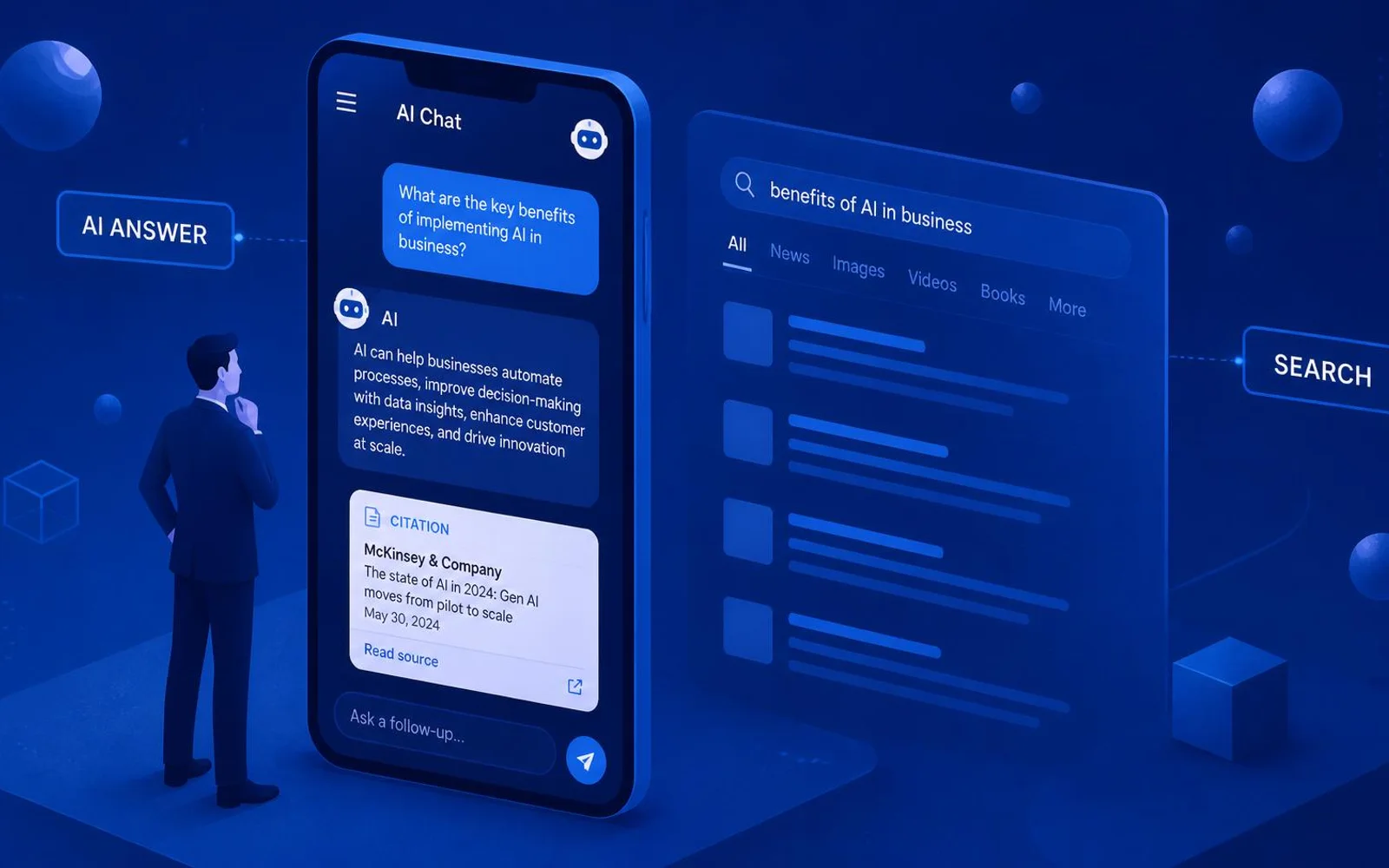
Top-of-funnel content used to have one job: rank, get clicked, get read. It now has a second audience that didn't exist a few years ago: the AI system deciding whether to name you in an answer at all.
AI Overviews are also just bigger than they were. More than 40% of US searches now trigger a Google AI Overview, up from roughly 15% about a year earlier (Elmo, 2026, based on panel-measured traffic data). Estimates vary by methodology, but the direction and the pace are consistent across credible sources.
AI Overviews tripled their reach in a year
Share of US Google searches that trigger an AI Overview.
Panel-based traffic measurement, reported by Elmo, 2026
That growth has a real cost for the human-click side of the funnel. Ahrefs analyzed 300,000 keywords and found that when an AI Overview appears, the click-through rate for the number one organic result drops by roughly 58%, from 0.073% to 0.016% (Ahrefs, reported via Medianama, Feb 2026).
That's not a reason to abandon top-of-funnel content. It's a reason to stop measuring it only by clicks. A meaningful share of its value now shows up as a citation the reader never clicks through on at all.
What earns that citation is mechanically different from what earns a ranking, and it's a shorter list than most teams think.
An extractable, direct answer in the first screen, rather than three paragraphs of throat-clearing before the point. Question-form headers that match how someone actually asks an assistant something, rather than noun-phrase headers written for a human skimmer. Proper schema markup so the structure is machine-readable, not just visually clean.
None of that is exotic. It's mostly editorial discipline that most content teams dropped somewhere around 2015, because it stopped mattering for human readers. It matters again now, for a different reader.
This is also where an original, ungated tool does real top-of-funnel work that a blog post can't. Deligatr's own AEO guide covers this in more depth, and the free AI Visibility and Conversion Audit answers the exact question this section is about: whether AI assistants are actually naming a business when a buyer asks.
It uses the same measured-versus-assessed discipline as everything else published under the Deligatr name. What's confirmed by a live grounded search stays separate from what's inferred from page markup. That distinction matters more here than almost anywhere else in content marketing right now, because most of what gets published about "AI visibility" in 2026 is either speculation or a vendor's own unverifiable claim.
Bottom of funnel: this is where AI is actually earning its keep
Top-of-funnel is where AI changes what gets cited. Bottom-of-funnel is where AI changes what gets bought, and this is the part of the funnel where the 2026 data is least ambiguous.
Gartner reports that nearly 40% of B2B buyers are now comfortable completing purchases over $500,000 through self-service or remote interaction, with no salesperson required to close the deal (Gartner, cited via The Higher Pitch).
That number should reset how most B2B teams think about gating. The instinct to put a form in front of every asset made sense when a buyer needed a rep to get information. It makes considerably less sense when the buyer has already done 60% of that work alone and now just wants to confirm they can move without friction.
The practical version of this: interactive tools that let a prospect get a real answer instead of asking a rep for one. Resource libraries organized by role and use case instead of a flat PDF dump. Pricing frameworks that set real expectations instead of "contact us."
One content marketing firm puts it plainly: companies that still gate every piece of content and force a sales call before sharing relevant information are, in their view, losing deals to competitors who make it easier (The Smarketers, B2B Marketing Trends 2026). That's a strategic argument rather than a measured finding, but it lines up with everything the buyer-behavior data above already shows.
This is where Deligatr's own bottom-of-funnel thinking shows up in practice, not just in theory. The AI Visibility and Conversion Audit returns a specific, real answer with no form and no gate. The value is in getting the answer, not in trading an email address for the privilege of maybe getting one later by email.
Where a gate does make sense, like a template library or a full report, it's because the gate itself is the delivery mechanism. It isn't a toll on information that should have been free.
The same logic applies to the CRM layer underneath all of this. A frictionless bottom-of-funnel motion falls apart the moment the lead it produces lands in a spreadsheet nobody checks. DeliHub exists specifically because the content and the pipeline it feeds need to be the same system. A free-forever CRM tier removes exactly the kind of adoption friction on the operations side that gated content creates on the buyer side.
Try it: score your own content against this framework
Reading a framework and applying it to your own site are two different things. This checks the second one, using the same dimensions this guide has been building toward: whether it gives an extractable answer, whether it links anywhere, whether it's clearly aimed at one funnel stage, whether it gates real value, and whether it cites anything original.
Content Strategy Score
Score your own content against this framework
Supplied by DeliBrief. Want this on your own blog articles?
Book a quick call and we'll implement it for youThe framework that actually ships: architecture, not a calendar
Most "content marketing strategy" documents are calendars with opinions attached. They fail for a boring, structural reason. A list of fifty blog post ideas with no relationship to each other produces fifty orphaned pages, each starting from zero authority, each competing with the others for the same internal links.
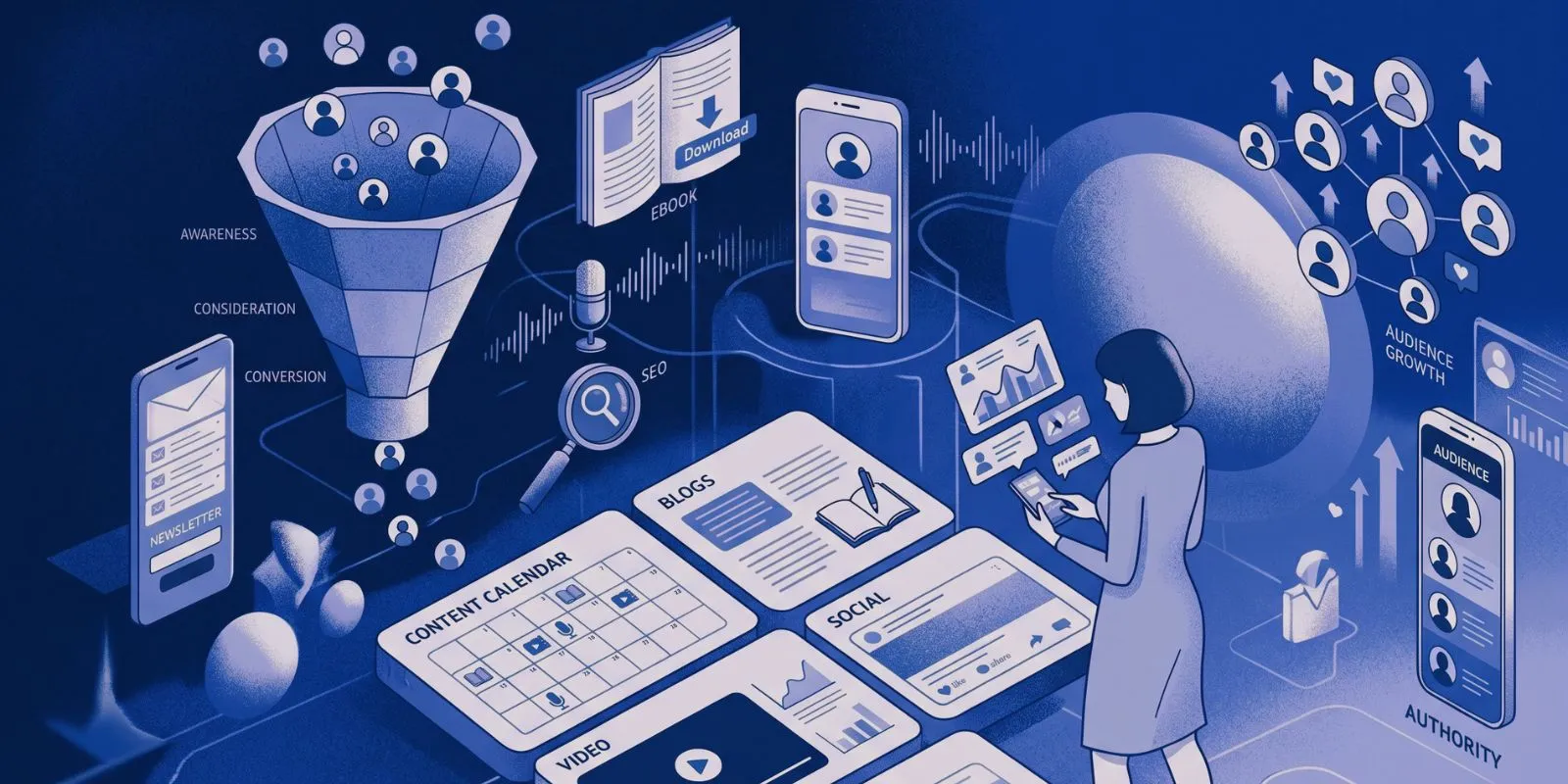
The framework that actually ships looks different. It's a small number of hubs, each owning a real topic. Cluster pages underneath each hub own the specific questions and intent variants inside that topic. A small number of asset types are layered across all of it, each doing a distinct job at a distinct funnel stage rather than every piece trying to do everything at once:
- Answer pages: one real buyer question per URL, direct answer in the first screen, tightly matched to top-of-funnel, AI-citation-shaped content.
- Glossary terms: cheap to produce, densely cross-linked, and the connective tissue that makes everything else discoverable internally.
- Comparisons: built for the exact moment a buyer is choosing between two or three named options, a bottom-of-funnel decision point rather than a top-of-funnel education point.
- Original benchmark data: the asset type a young or low-authority site can use to earn attention an incumbent's domain authority would otherwise make impossible. Nobody else can publish a number they haven't measured.
- Interactive tools: the clearest bottom-of-funnel friction-remover in the list, because they answer a buyer's specific question about their specific situation instead of a generic one. The Content Strategy Score above is one small example, and the same idea sits behind the AI Visibility Audit.
This is architecture Deligatr is building on itself, not just recommending. Every new guide in this blog links to at least a few existing ones within days of publishing. At low domain authority, internal linking is most of the authority a new page has access to before a backlink profile exists to do the work instead.
The AEO and content marketing categories on this blog are themselves two hubs built exactly this way: a home page for the topic, cluster posts underneath it, cross-linked deliberately rather than left to find each other. That's the part most "content strategy" advice skips, because it's not a creative decision. It's structural discipline, applied consistently, which is the same thing content marketing has always actually rewarded. The tooling just makes it possible to apply that discipline at a pace that wasn't realistic before.
A short, practical checklist
For a team trying to translate this into what changes on Monday:
- Audit before optimizing. Know which pages are cited by AI assistants and which aren't before deciding what to write next. Measured, not assumed. QualiPi is a free way to see which part of your own funnel is actually the weak point before you start writing.
- Write the extractable answer first, the argument second. The first sixty to eighty words carry more weight than they used to, for a reader and for a citation.
- Ungate the value, gate the delivery. A real, specific answer is a fair thing to give away. A definition or a comparison isn't worth gating at all.
- Put a real, verifiable person on it. Author credibility is now a machine-readable signal, not just a trust signal for a human reader.
- Link deliberately, not eventually. New content that nothing points to is orphaned content, regardless of how good it is.
- Measure the AI referral channel separately from organic. It's small today for almost everyone. In one analysis of over 100,000 websites, ChatGPT's worldwide referral share still grew 36.7% in a single month, from 0.23% to 0.32% of tracked traffic (SE Ranking, May 2026). The trend line is the point, not the current volume.
FAQ
Has content marketing actually changed because of AI?
The core discipline hasn't. Answer the buyer's question before the sale. Build trust consistently. Produce something that keeps working after publication. What's changed is production speed, how buyers research before contacting a vendor, and the fact that AI systems are now a second audience content has to satisfy alongside human readers.
Why do 95% of marketers use AI but only 39% say it is working?
Most teams adopted AI as a production tool without rebuilding the strategy it sits inside. They used it to make the same kind of content faster, not to change what gets made or how it's structured. Content Marketing Institute's 2026 research found the same pattern: strong productivity and efficiency gains, weak gains in actual content quality and performance.
What's the difference between top-of-funnel and bottom-of-funnel content in an AI-influenced buyer journey?
Top-of-funnel content now needs to satisfy two readers: a human skimming for an answer, and an AI system deciding whether to cite the page in a generated answer. Bottom-of-funnel content has a narrower job. It removes the friction between a buyer who has already done most of their own research and the point where they are ready to act, which increasingly means self-serve detail rather than another gated asset.
Should content still be gated behind a form?
Selectively. Gating makes sense when the gate is the actual value being delivered, like a template library or a full report. It stops making sense for content whose entire value is the information itself. A buyer who's already 60% through independent research has little patience for trading an email address for a definition they could get elsewhere.
What is an "answer engine" and why does it matter for content strategy?
An answer engine is an AI system such as ChatGPT, Perplexity, Gemini or Copilot that generates a direct answer to a query rather than returning a list of links. Getting cited inside that answer does not require the domain authority that ranking first in traditional search does. That makes it one of the few channels where a newer or lower-authority site can compete on the strength of the content alone.
How do you measure whether content marketing is working in 2026?
Organic clicks alone understate it, because AI citations and AI referral traffic often do not register as a click at all. A fuller picture tracks branded search volume, AI-assistant referral traffic as its own channel, and, further down the funnel, conversions by asset type rather than by page views.
Sources
- Content Marketing Institute, B2B Content & Marketing Trends: Insights for 2026
- MarketScale, 95% of B2B marketers use AI in 2026, but fewer than 4 in 10 say it's actually working (reporting CMI 2026 data)
- The B2B Content Show, B2B's AI adoption gap: 95% use it, 39% see results (reporting CMI 2026 data)
- CIO Dive, AI project failure rates are on the rise (reporting S&P Global Market Intelligence's 2025 enterprise survey)
- Apollo (citing Forrester), B2B Buyer Journey: What Actually Works in 2026
- Salesprep (citing Gartner), B2B buying journey 2026: the self-serve buyer
- Omnibound (citing McKinsey B2B Pulse Survey 2024 and Forrester State of Business Buying 2024), B2B Buying Statistics 2026
- The Higher Pitch (citing Gartner), B2B Buyer Journey 2026
- The Smarketers, B2B Marketing Trends 2026: Self-Serve, RevOps, AI
- Medianama (reporting an Ahrefs AI Overview CTR study), Google AI Overviews click-through rates -58% study
- Elmo, AI Overviews reach 43% of US searches (July 2026 data)
- SE Ranking, Referral traffic from ChatGPT hit an all-time high in May 2026