
For twenty years, inbound marketing ran on one quiet mechanical promise. Write something genuinely useful, rank for it, and a stranger clicks a blue link and lands on your site. That click was the whole transaction. It was how the value of the content got delivered, and it was how you knew it worked at all.
That promise is breaking, and I don't say that to be dramatic. SparkToro's most recent research, run with Similarweb's clickstream data across the first four months of 2026, found that 68.01% of US Google searches now end without a single click to any website. Up from 60.45% just two years earlier (SparkToro). Put in plainer terms: out of every 1,000 searches, only around 276 still reach the open web. The other 724 get answered right there on the results page and the visit that used to happen simply doesn't.
Fewer searches end in a click every year
Share of US Google searches that end without visiting any website.
SparkToro, 2026, using Similarweb clickstream data
If your definition of inbound marketing is "rank, get clicked, capture the lead," I understand why that number feels like the end of something. In my opinion it isn't the end of inbound. It's the end of a version of inbound that was always more fragile than it looked, because it depended entirely on one company's decision to keep sending traffic away from its own results page. Google spent the last two years quietly deciding to stop doing that for most queries. Inbound marketing has to answer for that shift, not retire because of it.
What inbound marketing actually is, underneath the tactics
Strip away the tooling and the acronyms and inbound marketing has always meant one thing: earn attention instead of renting it. HubSpot coined the term and built the methodology around a simple idea, attract people with something genuinely useful, engage them as they evaluate, and keep delivering value after they buy so the relationship compounds instead of resetting to zero with every campaign.
That principle hasn't changed and, in my opinion, it isn't going to. What's changed is the terrain it operates on. For most of inbound's history, "attract" meant one thing in practice: rank in Google. That was never actually the definition of inbound, it was just the dominant available mechanism for most of the 2010s and early 2020s. Now there's a second mechanism sitting right next to it, and treating it as optional is how a lot of otherwise good content teams are going to lose relevance over the next two years without fully understanding why.
The second channel: being the answer instead of the link
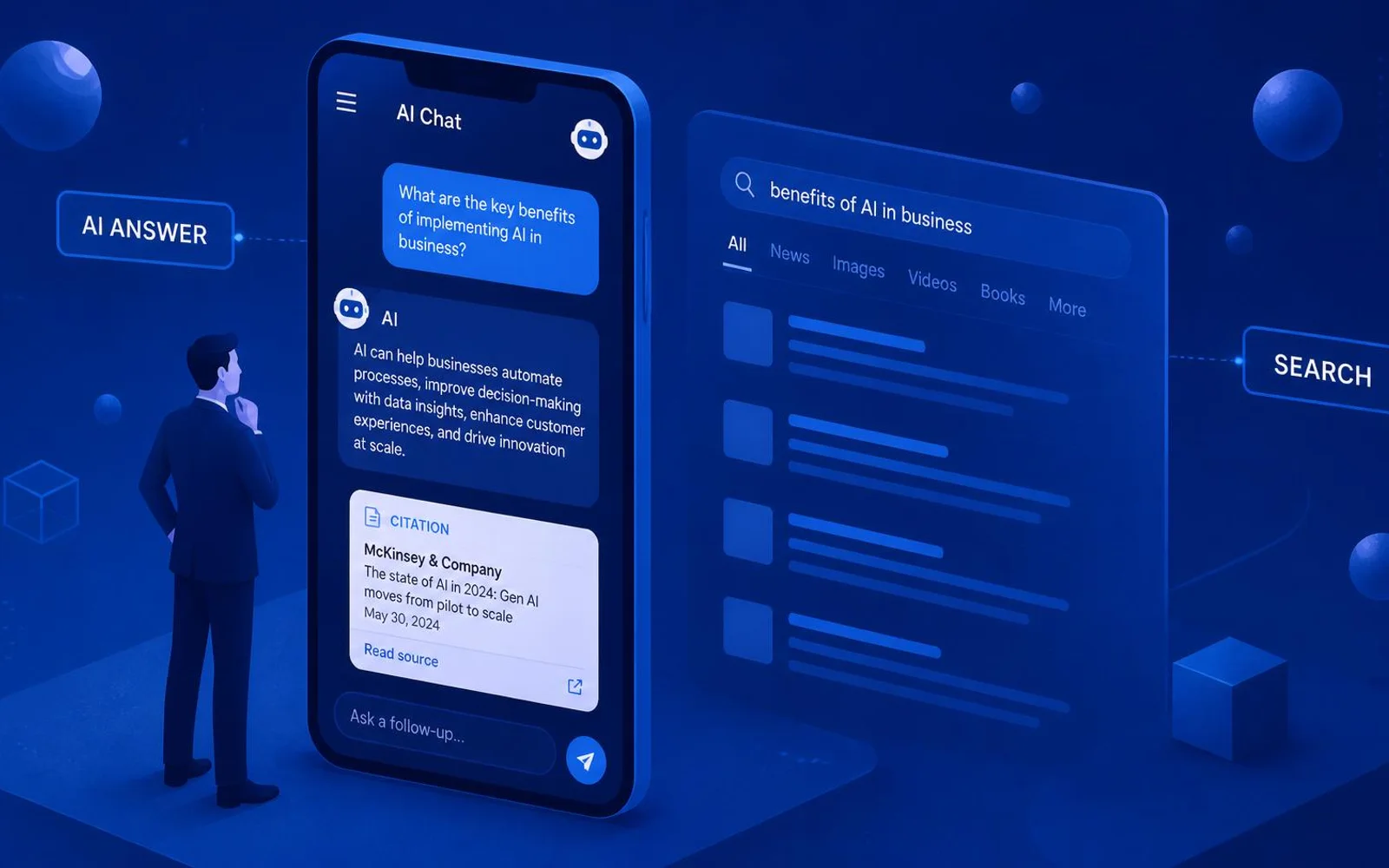
Here's the part I think most marketing teams still haven't fully absorbed. When an AI Overview appears on a search results page, click-through to the organic results underneath it drops by nearly 60%, according to Ahrefs' own analysis (Ahrefs, cited directly in SparkToro's research). That's not a small tax on visibility. For a huge share of informational queries, the query gets fully answered before anyone reaches the part of the page where your link would have sat.
Ranking well isn't what it used to be worth
Drop in click-through to the top organic result once an AI Overview appears above it.
Ahrefs, cited in SparkToro's 2026 research
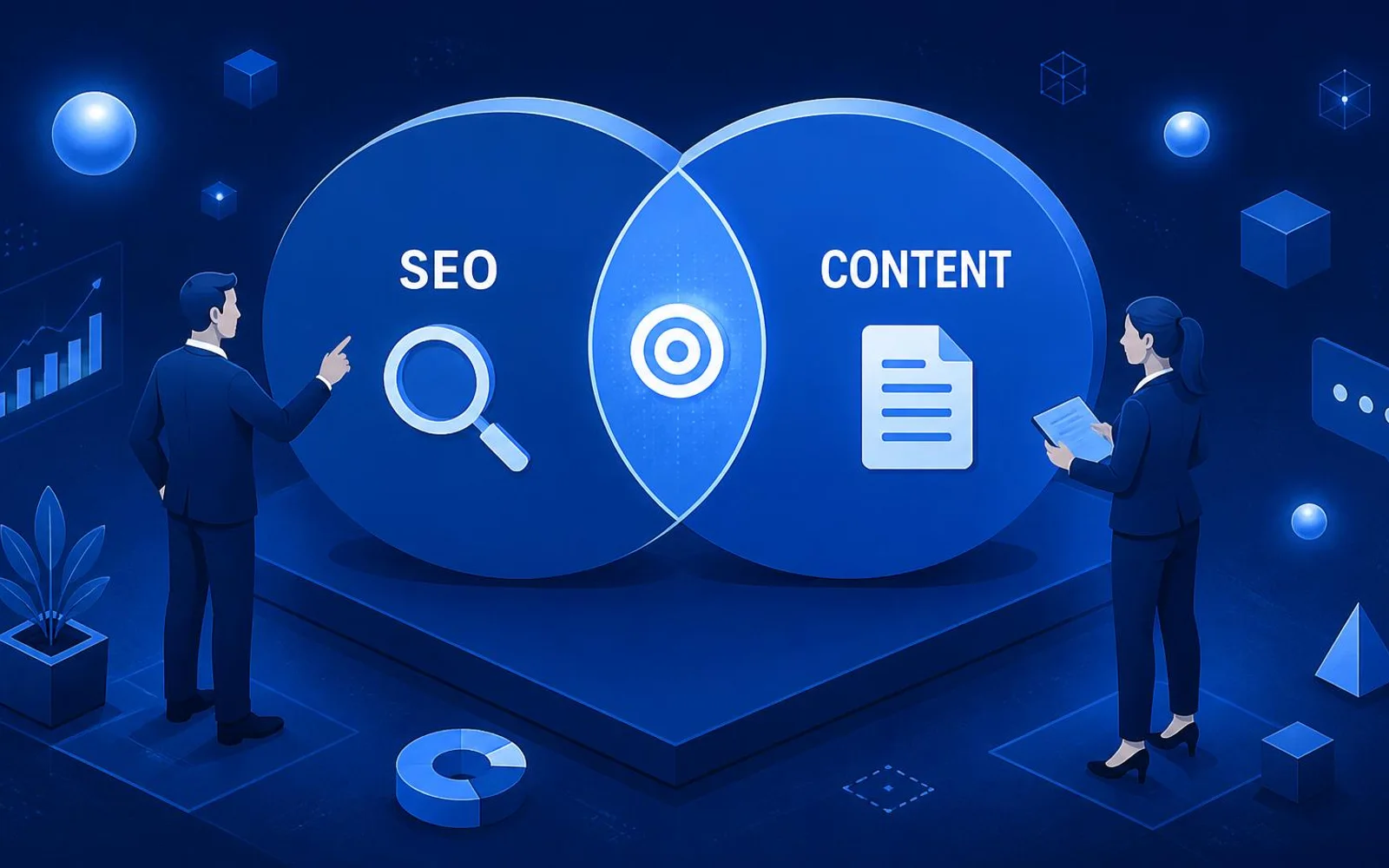
Answer engine optimization, AEO, and its close cousin generative engine optimization, GEO, exist to answer a different question than SEO does. SEO asks: how do I rank high enough that someone clicks through to my site. AEO asks: how do I get named, cited, or quoted inside the answer itself, in the moment before the click would have happened at all. Those are genuinely different disciplines with different mechanics, even though they share a lot of the same underlying content. Structure, direct answers, clean schema, and real citable original data all matter more here than backlink volume ever did. My AEO guide covers the mechanics of that in more depth.
I want to be precise about what I'm arguing, because it would be easy to overstate this. AEO is not a replacement for SEO. HubSpot's 2026 State of Marketing research found that over 92% of marketers now plan to invest in SEO for both traditional search and AI-powered engines, treating them as one connected discipline rather than choosing between them, and nearly 30% already report a decline in search traffic specifically because people are asking ChatGPT or Gemini before they ask Google at all (Averi, citing HubSpot's 2026 State of Marketing Report).
Marketers aren't choosing one over the other
What HubSpot's 2026 survey of marketers actually found.
HubSpot 2026 State of Marketing Report, via Averi
AEO is the second channel inbound marketing now has to run, sitting next to SEO, not instead of it. A team that only optimizes for the click is optimizing for a shrinking share of the actual attention available.
Why this genuinely is still inbound, not something new
I've seen a version of the argument that AEO is a completely different discipline, unrelated to what inbound marketing has always been about, and I don't buy it. Getting cited inside an AI-generated answer is earned the same way ranking in organic search was earned: by being genuinely useful enough that a system, human or algorithmic, chooses to surface you without being paid to. Nobody buys their way into an AI Overview citation the way they can buy their way into a paid search slot. It's attention earned through value, which is the entire definition of inbound marketing HubSpot wrote twenty years ago. The mechanism changed. The philosophy didn't move an inch.
What this actually requires from a content team is less dramatic than the AI hype cycle makes it sound, and more disciplined than most teams currently practice. Direct, extractable answers near the top of a page. Real schema markup so a machine can parse structure, not just a human reading it visually. Original data that nobody else has published, because an AI system summarizing a topic has to draw that summary from somewhere, and it increasingly draws it from whoever actually measured the thing rather than whoever wrote about it most recently. None of that is exotic. Most of it is editorial discipline that content teams have simply let slide over the last decade because it stopped being necessary for ranking. It's necessary again now, for a different reason.
What a free tool built for this actually looks like
I'll use our own example here because it's the cleanest illustration I have of what "inbound built for how buyers search now" actually means in practice, rather than just as a slogan.
We built a free AI Visibility and Conversion Audit specifically because the question "does an AI assistant even know we exist" didn't have a good, honest answer available anywhere. Most of what gets published under the banner of AI visibility right now is either speculation dressed up as insight, or a vendor's own unverifiable claim about their own tool's accuracy. Ours runs live, grounded queries against real AI assistants and reports back what's confirmed by that live check, kept clearly separate from anything that's inferred from a site's markup rather than actually observed.
The tool itself is the inbound play. Nobody has to talk to a salesperson to use it, nobody has to hand over a phone number to see the result. It's ungated because the value is in the answer, and gating an answer to a question this specific and this timely would be exactly the kind of friction that undermines the entire reason someone was looking for it. That's the model I think inbound marketing has to run on now, whether the channel bringing someone to the tool is a traditional search result or a citation inside an AI-generated answer. Earn the attention, give the value immediately, let the relationship start from a place of trust rather than a form field.
The tool below applies that same idea to a slightly different question. Not "does AI know you exist," but "given your actual situation, where should the effort go first."
Where should your inbound effort actually go?
Answer a few quick questions. Claude weighs SEO, AEO and original content depth specifically for your situation, no form, no email required.
What actually still works, stated plainly
If I had to reduce this to a short, honest list of what I think is actually true right now, rather than what's fashionable to say, it would be this.
Genuinely original content still wins, and now it wins twice. A benchmark dataset, a real survey, a piece of research nobody else has, earns backlinks the old way and earns AI citations the new way, using the same underlying asset. That's a better return on the same work than most content teams are currently getting.
Structure has stopped being a nice-to-have. Direct answers, clear headings that match how someone actually asks a question, and real schema markup are no longer stylistic choices. They're the mechanical requirement for being extractable at all, by a human skimming or a system summarizing.
The click was never actually the point, even though it was always the metric. The point was earning enough trust that someone chooses to engage with you instead of being pushed toward you. A citation inside an AI answer, with no click attached to it at all, can build exactly that kind of trust just as effectively as a visit used to, even though most analytics dashboards still don't have a clean way to show it.
Brand still matters more than most performance marketers want to admit. Research from the LinkedIn B2B Institute and the Ehrenberg-Bass Institute, based on how often companies actually switch B2B providers, puts roughly 95% of any given B2B category as not actively in-market at any single moment (B2B Institute / Ehrenberg-Bass, the 95-5 Rule). A huge share of what inbound marketing is actually doing is building the kind of familiarity that gets someone onto a shortlist eighteen months from now, long before they ever type a query that would show up in a dashboard today.
Almost nobody is ready to buy right now
Share of a B2B category actively in-market at any given moment.
95% Not in-market right now
5% In-market right now
This is who most demand capture targets.
LinkedIn B2B Institute and Ehrenberg-Bass Institute, the 95-5 Rule
The honest caveat
None of this makes the strategy easier, and I don't want to pretend it does. Running SEO and AEO well at the same time is more work than running SEO alone used to be, not less, because the two disciplines reward slightly different things even where they overlap. A team that treats AEO as a box to tick, a bit of schema bolted onto content that was never built to be extractable in the first place, will get exactly the shallow results that approach deserves. The teams that actually benefit from this shift are the ones treating it as what it is: inbound marketing adapting to a second real channel, with its own discipline, sitting permanently next to the first one.
And this isn't a 2026 problem that resolves itself once the calendar turns. The two-year climb from 60.45% to 68.01% didn't level off to hit a round number for this piece, and nothing about how AI assistants are being built suggests 2027 reverses that direction. Treat what's in this article as the standing shape of the channel going into next year, not a one-time adjustment for the year it happened to be written in.
Key takeaways
- SparkToro's 2026 research found 68.01% of US Google searches now end without a click, up from 60.45% in 2024. The classic inbound mechanic of rank, click, convert now applies to a shrinking share of total search volume.
- When an AI Overview appears on a results page, organic click-through drops by nearly 60% (Ahrefs, cited via SparkToro). AEO exists specifically to earn visibility inside that answer, not just below it.
- AEO is not a replacement for SEO. Over 92% of marketers plan to invest in both together, treating them as one connected discipline, per HubSpot's 2026 State of Marketing research.
- The underlying philosophy of inbound marketing, earn attention instead of buying it, applies just as directly to getting cited in an AI answer as it did to ranking in organic search. The mechanism changed. The principle didn't.
- Roughly 95% of any B2B category isn't actively in-market at a given moment (the B2B Institute and Ehrenberg-Bass Institute's 95-5 Rule), which is most of why brand familiarity still matters as much as any single conversion metric.
FAQ
Is inbound marketing still effective in 2026?
Yes, but the definition of "attract" has expanded. Ranking in traditional search is still part of it, but with 68% of US Google searches now ending without a click, a growing share of attention has to be earned through AI-generated answers rather than only through a click-through result.
What is the difference between SEO and AEO?
SEO optimizes for ranking high enough in search results that someone clicks through to a website. AEO, answer engine optimization, optimizes for being cited, quoted, or named directly inside an AI-generated answer, often without any click happening at all. They share much of the same underlying content but reward slightly different structural choices.
Does AI search mean inbound content doesn't need to be clicked to work?
It means a click is no longer the only way content delivers value or builds trust. Being cited by name inside an AI answer can build brand familiarity and credibility even without a visit, though it's harder to measure directly than a traditional pageview.
What should an inbound marketing agency actually be doing differently in 2026?
An agency still running a strategy built entirely around traditional keyword rankings is optimizing for a shrinking share of total search behavior. A modern inbound agency needs to run SEO and AEO as one connected discipline, structure content to be extractable by AI systems as well as readable by humans, and measure success beyond clicks, including AI referral traffic and brand mention frequency inside AI-generated answers.
How do you measure inbound marketing performance when so many interactions don't produce a click?
Traditional traffic and conversion metrics still matter but tell an incomplete story now. A fuller picture adds branded search volume, AI referral traffic tracked as its own channel, and, where tools exist for it, how often and how accurately a brand is named inside AI-generated answers to relevant category questions.
Sources
- SparkToro, In 2026, Less than One Third of Google Searches Still Send a Click
- Ahrefs, AI Overviews Reduce Clicks
- Averi (citing HubSpot's 2026 State of Marketing Report), HubSpot's 2026 State of Marketing in 90 Seconds
- LinkedIn B2B Institute and Ehrenberg-Bass Institute, The 95-5 Rule