
I want to walk through something most content marketing advice skips entirely: what's actually supposed to happen in the minutes and hours right after someone reads your content and shows real interest.
Not the strategy behind the content. Not the topic selection or the keyword research. The mechanics of what happens next, because that part is where I think most content marketing programs quietly lose the value they worked hard to earn.
Here's the uncomfortable stat that sets this up. The original Lead Response Management study, run by Dr. James Oldroyd at MIT in partnership with InsideSales.com in 2007, tracked more than 15,000 leads and over 100,000 call attempts across six companies. Contacting a lead within five minutes makes you roughly 100 times more likely to actually reach them, and 21 times more likely to qualify them, compared to waiting just 30 (MIT / InsideSales.com Lead Response Management Study, 2007).
Wait even a few minutes and the odds collapse
How much worse your odds get at 30 minutes versus 5 minutes.
MIT / InsideSales.com Lead Response Management Study, Dr. James Oldroyd, 2007
A follow-up Harvard Business Review study in 2011, auditing 2,241 US firms, found the average real-world response time sitting at 42 hours (Oldroyd, McElheran & Elkington, "The Short Life of Online Sales Leads," HBR, March 2011). Drift ran their own version of this test more recently, submitting real lead forms to 433 B2B SaaS companies, and found the same 42-hour average, with 55% never responding at all within five business days, and only 7% responding inside the five-minute window the original research points to (Drift Lead Response Survey).
The gap between what works and what companies do
Real-world response behavior, from two independent studies a decade apart.
Harvard Business Review, 2011, and Drift Lead Response Survey
Drag the clock forward
Watch what a lead's odds actually do while nobody's picked up the phone yet.
Odds you reach them
100.0%
Odds you qualify them
100.0%
Shown relative to the 5-minute mark, modeled between the two points the MIT / InsideSales study actually measured (5 and 30 minutes), not read from minute-by-minute research.
Read those numbers next to each other and the picture is stark. The research on what works has existed since 2007. The actual behavior of most companies hasn't moved in almost twenty years. In my opinion, that gap is not a sales problem. It's a content marketing problem, because the content team is the one that did the hard, expensive work of earning that moment of interest in the first place, and then handed it off into a process that reliably lets it go cold.
The loop, not the funnel
Most content marketing strategy gets described as a funnel: awareness, consideration, decision. That framing is fine for planning what to write, but it's a bad model for what actually needs to happen operationally. A funnel implies a one-way flow with content at the top and a sale eventually falling out the bottom, with no mechanism described for what closes the gap in between.
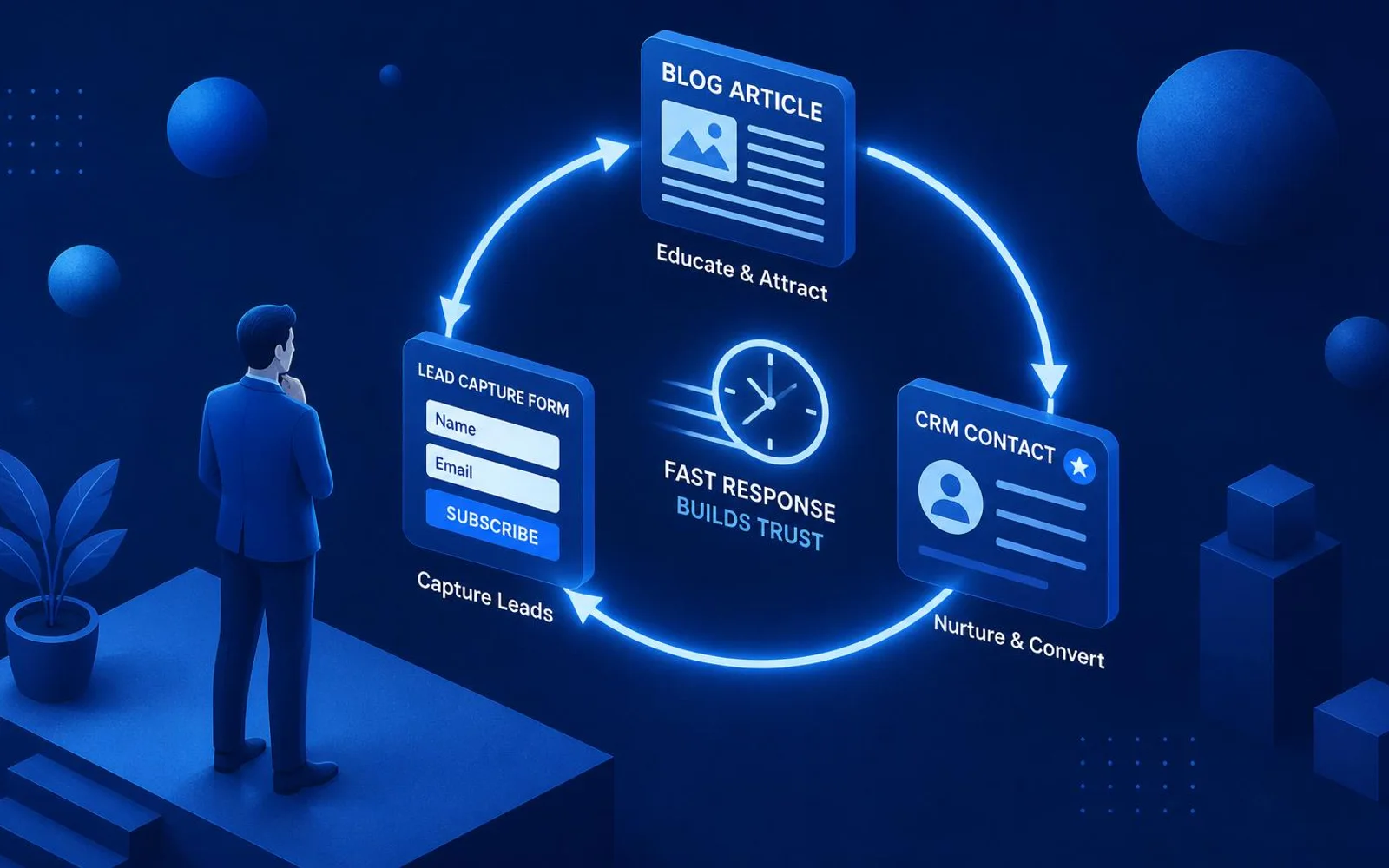
What I actually think in terms of, and what I'll walk through here, is a loop: content earns attention, identification captures it, a record gets created, and follow-up happens while the interest is still live. Every step depends on the one before it happening fast, not eventually.
A loop, not a funnel
Each step only works if the one before it happened fast. The cycle closes back into step one because every follow-up is itself a reason to keep publishing.
Content earns a visit
Identification captures it
Record created instantly
Follow-up fires automatically
I'll walk through this using our own stack, DeliChat into DeliHub into DeliMail and DeliReach, because it's the version of this loop I can describe with total precision, mechanically, not because it's the only way to build one. The mechanics matter more than the specific tools. If you're running something else entirely, the sequence below is still the thing to build toward.
Step one: the content does what content is supposed to do
This part isn't new and I've written about it elsewhere, so I'll keep it short. A piece of content earns a visit because it answered a real question well, in a format that respects how little time most readers actually give it (more on that here). That's the whole job of this step. It is necessary and it is not, on its own, sufficient, which is the entire point of everything below.
Step two: identification happens before a form does
Here's where most companies' loops break before they've even started. Industry benchmarks consistently put B2B website form conversion at somewhere between 2% and 5%, which means the overwhelming majority of visitors, even genuinely interested ones, leave without ever identifying themselves at all. The content did its job. The visit happened. And then, for 95% or more of those visits, nothing captures the fact that it happened in any way a sales process can act on.
This is the specific gap DeliChat exists to close. It identifies the company behind an anonymous visit and starts scoring intent immediately, based on real engagement signals rather than just the fact that a session occurred. How far someone actually scrolled. Whether they came back a second time. Whether they read a page that signals real evaluation, like a pricing page or a comparison page, versus a page that signals early, casual research. None of that requires a form. It requires the visit to happen at all, which is the one thing the content already earned.
Step three: the record gets created the moment identification happens, not later
This is the step I think gets underrated the most, because it sounds almost too simple to matter. Once DeliChat identifies a visitor and their intent crosses a meaningful threshold, DeliHub logs them as a record immediately. Not at the end of the day when someone exports a report. Not after a human on the marketing team notices a spike in a dashboard and manually adds a row to a spreadsheet. The moment the signal exists, the record exists.
I keep coming back to this step specifically because it's the one most manual processes quietly fail at even when every other part is working. A marketing team can be genuinely good at producing content and genuinely good at watching analytics, and still lose most of the value of both if the handoff from "we noticed interest" to "there is now an actionable record a salesperson can work" depends on a person remembering to do something.
Automating that single handoff is, in my experience, the highest leverage fix available to most content-driven pipelines, and it's also the one nobody budgets time for, because it doesn't feel like content work or sales work. It sits exactly in the gap between the two teams, which is usually where it goes to die.
Step four: follow-up happens while the interest is still real
This is where the speed-to-lead research from the opening of this piece actually earns its place in an article about content marketing. Once a record exists in DeliHub with a real intent score attached to it, DeliMail and DeliReach, and DeliVoice where a call is the right next step, can follow up automatically, triggered by the score itself rather than by a human noticing it later.
That's the mechanical answer to the 42-hour average response time problem described above. The gap between "someone showed real interest" and "someone followed up on it" stops being a function of whoever happens to check the dashboard that day, and becomes a function of the system firing the moment the threshold is crossed.
I want to be specific about why this matters more for content-sourced leads than for a cold list. A cold outbound contact has no context and no urgency clock running. A visitor who just read a comparison page and came back a second time within 48 hours is operating on a much shorter window of relevance. The MIT/InsideSales research found qualification odds dropping sharply within the first 30 minutes of a lead going cold. Content-sourced intent decays on a similar, sometimes faster, clock, because the reader's curiosity was specific and current, not evergreen.
Following up an hour later isn't a minor inefficiency here. It's very often the difference between reaching someone who still remembers exactly what they were evaluating, and reaching someone who has moved on to three other tabs and forgotten the context entirely.
What this looks like without the loop, honestly
I think it's worth describing the alternative plainly, because most companies are living inside it right now without fully seeing it as a system.
Content gets published. Traffic arrives. Somewhere between 95 and 98% of that traffic leaves without filling out a form, and nothing captures that it happened. Of the small remainder who do fill out a form, that lead lands in a CRM, sometimes automatically, often through a manual export, and sits in a queue until a sales rep has a free moment, which the research above says averages somewhere around two days. By the time contact happens, the reader has frequently forgotten which company they even reached out to, let alone what question they originally had.
Of the small number of people who do fill out a form
How fast the average B2B company actually responds.
7% responded within 5 minutes
38% responded later, within 5 business days
The remainder, by elimination.
55% never responded within 5 business days
Drift Lead Response Survey, 433 B2B SaaS companies
None of that is a failure of the content, and none of it is a failure of the sales team either. It's a failure of the handoff between them, and handoffs are exactly the kind of thing that never belong clearly to one team's job description, which is precisely why they're the part that goes unbuilt.
Building this loop with whatever stack you're actually running
The specific tools matter less than the sequence, so here's the version of this that applies regardless of what you're using.
Instrument identification before you instrument anything else. If you can't see who's visiting beyond a pageview count, nothing downstream of that can be fast, because nothing downstream of that even knows an opportunity exists yet.
Define an intent threshold, not just a lead source. A visit is not a lead. A specific pattern of engagement, real page depth, a return visit, a high-intent page viewed, is what should trigger the next step, not simply "someone showed up."
Automate the handoff from signal to record. This is the step to prioritize before anything else if you're building this from scratch. A fast follow-up process built on top of a manual, delayed record-creation step will still be slow, because the delay just moved one step earlier.
Match the follow-up speed to how the research actually behaves. Minutes, not hours, for anything crossing a genuine high-intent threshold. The data on this hasn't changed meaningfully since 2007, only the tools available to actually hit the target have.
Audit your real response time before assuming you're fine. Drift's test of 433 companies found only 7% actually hitting the five-minute window even when asked directly about their own process. Most teams believe they're faster than they are until someone actually times it.
Key takeaways
- Research dating back to a 2007 MIT/InsideSales study, confirmed by a 2011 Harvard Business Review audit and more recent testing from Drift, consistently finds five-minute response times converting dramatically better than even 30-minute ones, while the real-world average response time across B2B still sits around 42 hours.
- Content marketing's job is to earn a visit. That's necessary but not sufficient. The value leaks out in the handoff between earning interest and acting on it, not in the content itself.
- 95% or more of website visitors never fill out a form, meaning most interest content earns is invisible to a manual process entirely, regardless of how good the content was.
- The loop that closes this gap has four steps: content earns the visit, identification captures it without needing a form, a record gets created the instant identification happens, and follow-up fires automatically once an intent threshold is crossed, not whenever a human happens to notice.
- Automating the handoff between "interest was detected" and "a record exists" is usually the single highest-leverage fix available, because it's the step that sits between teams and therefore belongs to neither one by default.
FAQ
What does "closing the loop" mean in content marketing?
It means connecting the moment content earns a reader's attention to the moment someone actually follows up on that interest, without a manual, delay-prone process sitting in between. Content marketing that only measures traffic and leaves the handoff to sales unaddressed is measuring half the system.
Why does response speed matter so much for content-sourced leads specifically?
A reader who just engaged with specific content is operating on a short window of relevant context. Research on lead response time consistently shows qualification odds dropping sharply within the first 30 minutes to an hour of a lead going cold, and content-sourced interest tends to decay on a similarly fast clock, since it was tied to a specific, current question rather than a general, evergreen one.
How long does the average B2B company actually take to follow up on a lead?
Multiple independent studies, from a 2011 Harvard Business Review audit of 2,241 firms to a more recent Drift test of 433 B2B SaaS companies, consistently find the real-world average sitting around 42 hours, despite research on the ideal response window existing since 2007.
Do you need visitor identification technology to build this kind of loop?
It is the piece that makes the rest possible. Without a way to identify and score anonymous visitors, the vast majority of genuine interest, the 95% or more of visitors who never fill out a form, simply never enters the loop at all, regardless of how fast the follow-up process downstream is.
What's the single highest-leverage step to fix first?
Usually the handoff between detecting interest and creating an actionable record. It's the step most likely to be manual, delayed, or entirely missing, because it sits between the content team and the sales team and rarely belongs clearly to either one's job description.
Sources
- MIT / InsideSales.com, Lead Response Management Study, Dr. James Oldroyd, 2007
- Harvard Business Review, The Short Life of Online Sales Leads, Oldroyd, McElheran & Elkington, March 2011
- Drift, Lead Response Survey, archived
- Ainora, Lead Response Time: Every Study (MIT, HBR, Drift)