
Let me tell you a story about the best piece of SaaS content I read all year, and the exact moment it lost me.
I was evaluating an expense management tool for a client a few months back. Found a genuinely excellent blog post while I was digging around, 2,400 words, real product screenshots, a benchmark table with numbers I hadn't seen anywhere else. Whoever wrote it knew the product and knew the category. I read the whole thing, which barely ever happens, and I got to the end convinced.
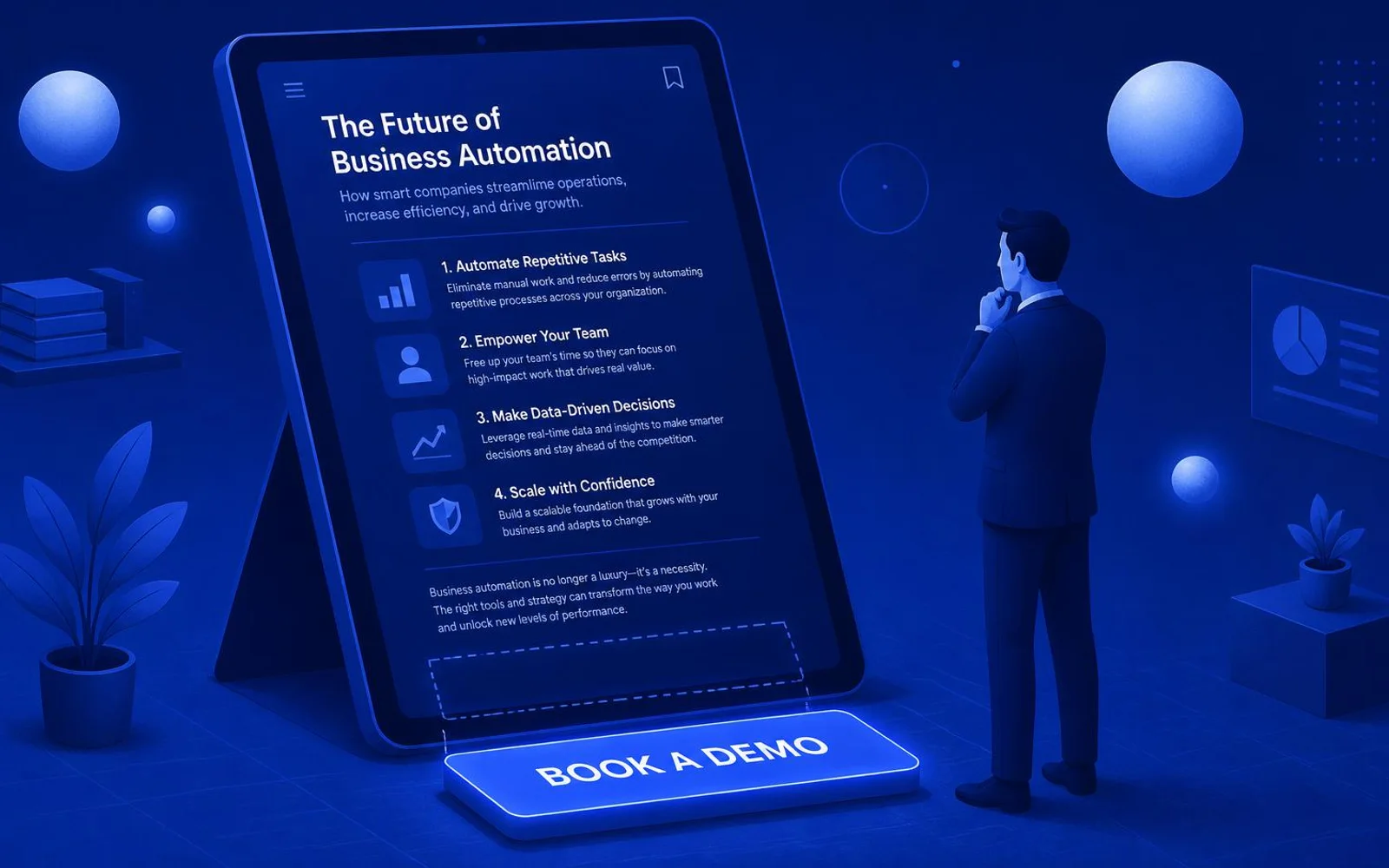
Then I hit the button.
Book a Demo.
I did not want a demo. I wanted to try the thing. I wanted to open it, put in three real expense reports, and find out in fifteen minutes whether it actually solved my problem, not sit through a thirty minute call with a rep working from a deck before I'm allowed to touch the product myself. I closed the tab. I did not go back. Two weeks later I could not tell you the name of the tool if you paid me.
That is not a story about bad content. The content did its job perfectly. It built trust, it explained the category, it made me want the product. The team behind it did the hard part right and then handed the easy part, the actual ask, to a form that asked for more than the reader was ready to give. In my opinion, that gap is the single biggest reason SaaS content marketing has a conversion problem, and almost nobody talks about it, because everybody is busy arguing about topics and keywords instead of looking at what happens in the last three seconds before someone leaves.
The numbers back up what happened to me
I am not just going off one bad experience. The data on SaaS content conversion is genuinely rough, and it has been rough for a while.
Blog content in B2B SaaS converts somewhere between 0.5% and 2% on a good day, while high intent pages like comparisons can reach 3 to 10% (Ten Speed). That gap is not really about topic or traffic quality. Comparison pages convert higher because the reader arrives already deciding, and the page asks for something proportionate to where they are.
Where B2B SaaS content actually converts
Typical conversion rate by page type.
Typical range: 0.5% to 2%.
Typical range: 3% to 10%, arriving already deciding.
Ten Speed, B2B SaaS benchmarks, 2026
A blog post that spent 2,000 words educating someone who just discovered the category, then asks for a sales call at the end, is asking a first date question on a first date and expecting a yes.
Here is the number that made me actually change how I think about this. Across product led growth companies, free accounts sourced through the product, meaning someone actually used it, convert to paid customers at 25 to 30% (ProductLed). Free accounts sourced the traditional way, through a marketing qualified lead and a form, are commonly benchmarked at 5 to 10% across multiple industry analyses of the same PLG data. That is not a small gap. That is the difference between a channel that works and one that mostly does not.
The PQL advantage
Free-to-paid conversion, by how the lead actually arrived.
25% to 30%, up to 30% to 39% for $1k-$5k ACV deals.
Commonly benchmarked at 5% to 10%.
ProductLed PLG benchmark data, 2026
Freemium tiers specifically convert site visitors to signups at a median of 12%, and companies running product led motions grow revenue roughly 50% faster than sales led competitors while spending 39% less to do it (SHNO, citing QuickMarketPitch and OpenView Partners data). I read stats like that and I think most SaaS content teams are optimizing the wrong half of the funnel. The writing gets workshopped for weeks. The button at the bottom gets whatever the sales team asked for eighteen months ago, and nobody has revisited it since.
Forms are a tax on interest, and the tax rate is steep
I want to be specific about why the form itself is the problem, because "reduce friction" is the kind of advice that sounds true and gets ignored anyway.
HubSpot analyzed more than 40,000 landing pages and found a clear, consistent relationship between form field count and conversion rate. More fields, lower conversion, straight through the whole dataset (HubSpot). A separate study of 404 landing pages found single field forms converting at 18.2%, dropping to 13.0% with two fields and 11.5% with three (Neil Patel).
Every field costs you conversion
Landing page conversion rate, by number of form fields.
Falls under 10%.
Neil Patel, analysis of 404 landing pages
Every field is a small ask. A reader who just spent four minutes reading your content still has to decide whether your name, work email, company size, phone number, and "what are you looking to solve" text box are worth the next thirty seconds of their life. Most decide they are not.
The frustrating part is that this is almost always fixable, and it is fixable without touching a single sentence of the actual content. The content already did its job. It earned the click. The form is where that earned trust gets spent on the wrong thing, asking for information the company wants instead of giving the reader the thing they actually came for.
The CTA is the product, not a form
Here is where I will say something that might sound like I am pitching my own company, because I am, but I think it is true regardless of who says it. We run DeliHub, our CRM, on a free forever tier. Not a fourteen day trial that quietly expires. Not a demo request that routes to a calendar link. You sign up, and you are in the actual product, with real functionality, immediately.
I did that on purpose, and the reasoning is exactly the argument I just made with somebody else's data. Every piece of content we publish ends somewhere, and where it ends matters more than almost anything in the piece itself. If the CTA at the bottom of an article about CRM pipeline hygiene is "book a call to learn more," I am asking a reader who just spent five minutes reading about pipeline hygiene to now spend thirty more minutes convincing a stranger they are worth talking to. If the CTA is "start using it," the product itself finishes the sale that the content started.
That is what I mean when I say the CTA is the product, not a form. The form asks the reader to prove they are worth our time before we prove the product is worth theirs. The free tier reverses that, and reversing it is precisely why product led companies see conversion numbers meaningfully higher than the form led version of the same funnel.
I will also say the honest part out loud, because I do not think this works for everything. A genuinely complex enterprise product with a six figure contract and a twelve stakeholder buying committee probably does need a real conversation before anyone touches it, and pretending otherwise would be dishonest content marketing of a different kind. But most SaaS content is not written for that buyer. Most of it is written for someone doing early research, and that reader should never be asked for a phone call. They should be asked to try the thing.
Don't take my word for it. This next part is powered by Claude, Anthropic's AI: paste in your own CTA, headline and all, and it scores the friction the exact same way I just described, then rewrites it live, no form required to use it.
See your own CTA next to a version that converts
No form, no email. Paste your real CTA, get a rewritten version in seconds.
What I actually check before we publish anything
A few things I look at now on every piece before it goes live, most of which have nothing to do with the writing itself.
Does the CTA match how far along the reader actually is. A definitional piece explaining what a term means should not end with a demo request. It should end with something proportionate: an ungated tool, a related resource, or a low commitment next step. Save the higher commitment asks for content written for someone already deep in evaluation.
Would I personally click this button, right now, having just read this. I ask myself that honestly instead of assuming the reader is more motivated than I would be in the same seat. Most of the time the honest answer tells me the CTA is wrong.
How many fields stand between interest and access. If the answer is more than two or three, I want to know why, and usually there is not a good answer beyond "that's what the form has always asked for."
Does clicking the button actually deliver the thing that was promised. A calculator that promises an instant number should give an instant number, not collect an email first and promise to follow up. A free tier that promises free should not ask for a credit card at step two. The gap between what the button says and what actually happens next is where trust gets spent fastest, and it does not come back easily once it's gone.
One email a week. The guide behind it, not around it.
New revenue-engine guides as they publish, plus the occasional real number from Deligatr's own campaigns. No filler, unsubscribe whenever.
What I think most SaaS content teams get backwards
If I had to put my actual opinion in one sentence, it's this: most SaaS content marketing treats the article as the product and the CTA as an afterthought, when the truth is closer to the opposite. The article's whole job is to earn one moment of trust. What happens in that moment determines whether the previous 2,000 words meant anything at all.
I have seen genuinely excellent content lose to genuinely mediocre content more than once, purely because the mediocre content ended in something the reader could actually say yes to, and the excellent content ended in something they had to think twice about.
Write the good content. That part still matters and I am not arguing otherwise. But before publishing, look hard at the button underneath it, and ask honestly whether you would click it yourself, right now, having just read what you wrote.
This is part three of a loose series on the same underlying argument: content marketing strategy covers the architecture, why nobody reads past the first screen covers what happens before someone even gets to the CTA, and this one is about the moment right after.
Key takeaways
- SaaS blog content converts at roughly 0.5% to 2% on average, while high-intent pages like comparisons reach 3% to 10%. The gap is mostly about whether the ask matches the reader's stage, not content quality.
- Product-qualified leads, people who signed up and touched the product, convert to paid at 25% to 30%. Form-qualified leads are commonly benchmarked at 5% to 10%. That is the real cost of a form-led CTA versus a product-led one.
- HubSpot's analysis of 40,000+ landing pages and a separate 404-page study both found conversion drops consistently as form fields increase, from 18.2% on a single field to under 10% by the fourth.
- DeliHub's free forever CRM tier exists specifically because of this logic. The CTA is the product itself, not a gate in front of it.
- Complex, high-ACV enterprise products may genuinely need a sales conversation before signup. Most SaaS content is not written for that buyer, and treating every reader like they are is where the conversion problem usually starts.
FAQ
Why does SaaS content marketing convert so poorly on average?
Mostly because the call to action at the end of a piece often asks for more commitment than the reader is ready to give at that stage. Blog content aimed at someone early in research frequently ends with a demo request, which is a sales-stage ask applied to an awareness-stage reader.
Is a free trial better than a demo for converting content readers?
It depends on the product and deal size. For most self-serve or low-to-mid complexity SaaS products, a free tier or trial converts markedly better than a gated demo request, because it removes the trust step between interest and access. For genuinely complex, high-ACV enterprise products, a qualifying conversation may still be the right ask.
How many form fields should a SaaS content CTA ask for?
As few as possible, and ideally none if the CTA leads to a free tier rather than a form. Data across large landing page studies consistently shows conversion dropping with each additional field, with the steepest early drop-off happening between one field and four.
What is a product qualified lead, and why does it convert better?
A product qualified lead, or PQL, is someone who has actually used the product, usually through a free tier or trial, rather than someone who only filled out a form expressing interest. PQLs convert to paid customers at a meaningfully higher rate than form-sourced marketing qualified leads, because the product itself has already done part of the persuading.
Should every SaaS company offer a free forever tier?
Not necessarily. It depends on the cost of serving a free user and the complexity of the product. But the underlying principle, that a CTA should ask for the smallest commitment that still lets the reader evaluate real value, applies regardless of whether the mechanism is a free tier, a short trial, or an interactive tool.
Sources
- Ten Speed, Content Marketing Conversion: What Good Looks Like for B2B Teams in 2026
- ProductLed, Product-Led Growth Benchmarks: Key SaaS Findings and Trends
- SHNO (citing QuickMarketPitch and OpenView Partners PLG benchmark data), Product-Led Growth Statistics for 2026
- HubSpot, Which Types of Form Fields Lower Landing Page Conversions
- Neil Patel, Landing Page Conversion Rate by Form Fields