
Key takeaways
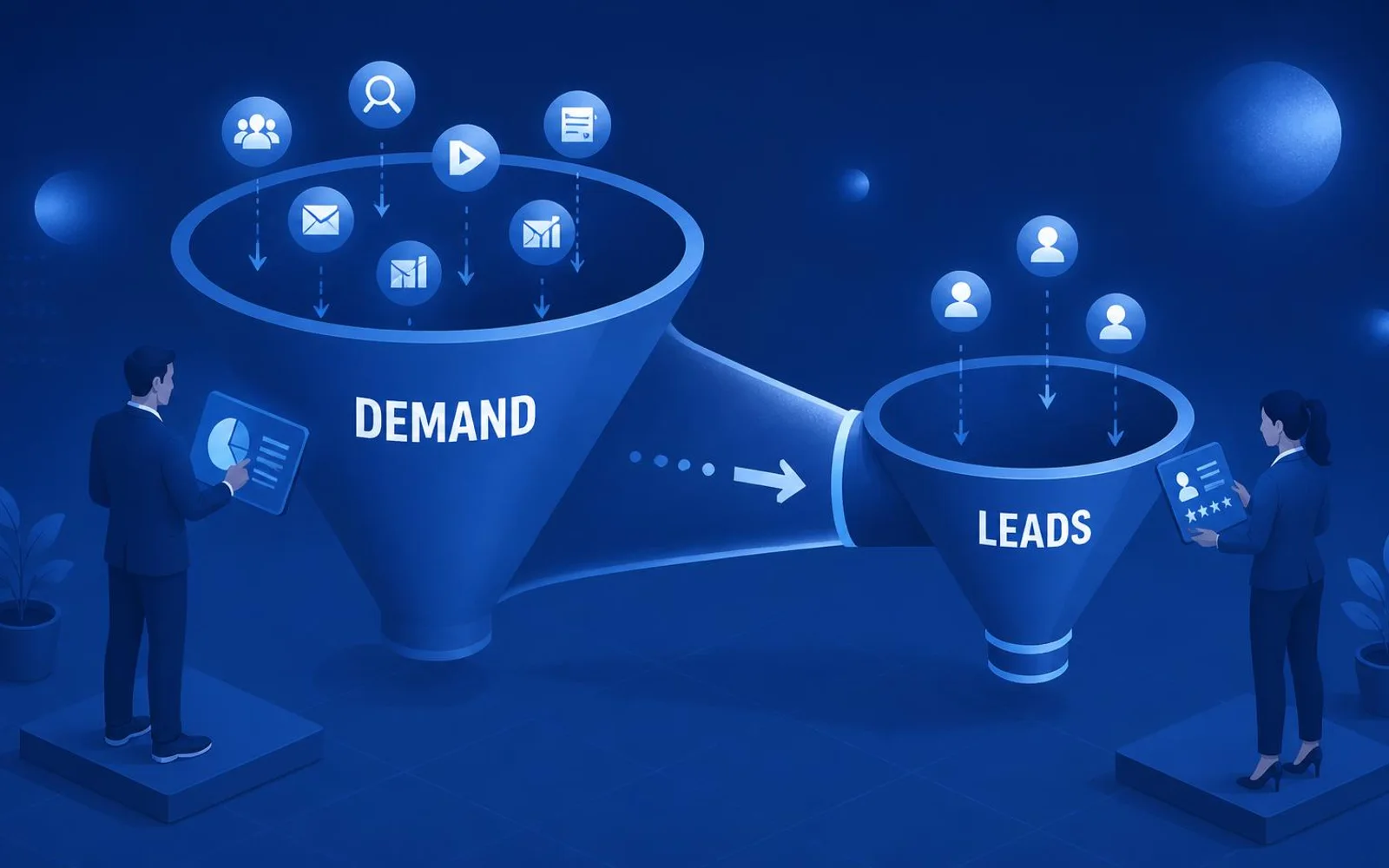
- Demand generation creates awareness and interest in a category before anyone is ready to buy. Lead generation captures the contact details of people who are already interested. They're sequential, not competing.
- 94% of B2B buying groups rank a preferred vendor before they ever contact a salesperson, and that early favorite wins the deal 77% to 81% of the time. If demand generation isn't shaping that early shortlist, lead generation is capturing names for a decision that's effectively already made.
- Most B2B websites convert only 2% to 5% of visitors into a known lead through a form. That means 95% to 98% of the people demand generation successfully attracted leave without identifying themselves at all, a gap that sits between the two disciplines and is usually nobody's job to close.
- Gartner's CMO Spend Survey puts marketing-sourced pipeline at a median of 41% and marketing-influenced pipeline at 71%. Most of marketing's real contribution to revenue doesn't come from a single lead-gen form fill.
- The strongest B2B programs run demand generation to build the shortlist and lead generation, warmed by that awareness, to capture and convert it. Connected through one record, not two systems that never talk to each other.
Two terms, used interchangeably, that mean genuinely different things
Ask five B2B marketers to define demand generation and lead generation and you'll get five overlapping but distinct answers. That's informative on its own. It means most teams run both disciplines without a shared definition of what each is actually for.
The cleanest version, consistent across current marketing research: demand generation creates awareness and interest in a problem and a category, before a buyer is ready to identify themselves. It's top-of-funnel, long-horizon work: content, thought leadership, original research, community presence, aimed at people who don't yet know they're a lead.
Lead generation captures the contact details of people who've already shown interest, converting that awareness into a named, follow-up-able contact. HubSpot frames it simply: demand generation educates and builds trust before a sale is on the table, while lead generation showcases the product and asks for the details (HubSpot). Cognism lands on the same split: demand generation is the long-term work of building awareness and trust before someone is ready to speak to sales, while lead generation is about converting that interest into leads a sales team can follow up on (Cognism).
That distinction sounds academic until you look at what it does to lead quality. ZoomInfo puts it plainly: a lead already warmed by awareness content typically converts from marketing-qualified to sales-qualified at a higher rate than a cold-sourced contact with no prior engagement (ZoomInfo). Skip the demand generation step and lead generation is capturing names cheaply and converting them expensively.
Why the mix-up costs real pipeline
Most B2B purchase decisions are effectively made before a lead is ever "generated" in the traditional sense.
6sense's 2025 Buyer Experience Report surveyed close to 4,700 B2B buyers across North America, Continental Europe, the UK and Ireland, and Asia-Pacific. 94% said their team had a preferred vendor ranked before engaging with any seller or SDR. That early favorite went on to win the deal 77% of the time in the main survey, and 81% of the time in a supplemental follow-up (6sense, 2025 Buyer Experience Report).
The decision is largely made before you're in the room
What happens once a buying group has a preferred vendor.
n=3,744.
6sense, 2025 Buyer Experience Report, ~4,700 B2B buyers
The buying journey has also compressed. 6sense's research found the split between independent research and seller engagement moved from roughly 70/30 to roughly 60/40 in the latest cycle (6sense). Buyers are making contact slightly earlier, not because they want more help from a salesperson, but because the tools they use to research have gotten faster.
The research window is shrinking
Share of the buying journey spent in independent research, before a seller is involved.
6sense, 2025 Buyer Experience Report
A program built entirely around lead generation is trying to win a decision at the exact moment it's already mostly decided. Demand generation is what shapes the shortlist before that point exists. Skip it and go straight to capture, and most of the persuasion work that determines who wins never happens on your terms at all.
The gap between the two that quietly loses the most pipeline
Here's the part of this that rarely gets its own section, and it's the most fixable problem in the whole discussion.
Demand generation does its job. A piece of content ranks, an AI assistant cites it, a prospect reads it and comes to the website. Then, overwhelmingly, that visitor leaves without becoming a lead at all.
Industry benchmarks put B2B website form conversion at roughly 2% to 5% (Tomba), with some estimates tighter still at 2% to 3% (Launch Leads). Either way, the large majority of the traffic demand generation worked to attract disappears without ever showing up as a lead generation outcome.
Most of your best traffic leaves without a trace
What happens to visitors a demand generation program successfully attracts.
Estimates range from 2% to 5% depending on the source.
Tomba and Launch Leads, 2026
That's not a demand generation failure or a lead generation failure. It's the seam between the two disciplines, and in most organizations, closing that seam isn't clearly anyone's job.
This is precisely the gap visitor identification technology exists to close: resolving anonymous site traffic to a named company, sometimes a named contact, without requiring a form fill. Deligatr's own answer to this is DeliChat. It identifies anonymous visitors and attaches an intent score to them as they engage, so a visit that would otherwise be one of the 97% that leave no trace instead opens a file that DeliHub, the CRM underneath it, can act on.
The point isn't the tool. It's that demand generation and lead generation stop being two separate budgets measured by two separate teams, and start being one funnel with a single record moving through it.
Where AEO fits: demand generation's newest top-of-funnel channel
Traditional demand generation content competes for a ranking. A newer, related discipline, answer engine optimization, competes to be the source an AI assistant cites when a buyer asks it to name vendors in a category. That's happening earlier and earlier in the buying journey.
G2's own research found 29% of buyers now start category research with an AI assistant instead of a search engine. Similarweb's traffic data backs that up directly: ChatGPT is already a top-ten traffic source for major B2B research destinations, at 3.37% of Forrester's traffic, 2.97% of Gartner's, and 1.49% of G2's own (Smart Marketer, citing Similarweb and G2 data).
AI assistants are already inside B2B research
How far ChatGPT has moved into the category-research habits of B2B buyers.
G2 and Similarweb data, via Smart Marketer, 2026
Being cited by an AI assistant doesn't require the domain authority that ranking first in traditional search does. That makes AEO one of the few top-of-funnel channels where a newer program can compete on the strength of the content alone rather than years of accumulated backlinks. Deligatr's AEO guide covers the mechanics of this in depth. Functionally, it's the same job demand generation has always had: be present and credible at the exact moment a buyer is forming their shortlist, just earlier, and through a different mechanism than it used to be.
Why the strongest programs don't choose
Nothing in the current data supports treating demand generation and lead generation as competing budget lines. Gartner's CMO Spend Survey puts marketing-sourced pipeline at a median of 41% of total pipeline, up from 38% the year before, and marketing-influenced pipeline at 71% (Digital Applied, citing Gartner's CMO Spend Survey). A gap that wide only makes sense if a large share of marketing's real contribution comes from awareness work that shaped a deal without directly "generating" the lead that closed it.
Account-based programs that combine both disciplines, awareness built for a specific target list, then capture mechanisms aimed at that same list, back this up with a hard number. ABM Leadership Alliance and Demandbase research puts account-based programs at $14.20 in pipeline per marketing dollar spent, against $5.40 for broad-reach demand generation run in isolation. Roughly 2.6 times more (Digital Applied, citing ABM Leadership Alliance, Demandbase and 6sense, 2026).
Account-based programs outperform broad-reach demand gen
Pipeline generated per marketing dollar spent.
ABM Leadership Alliance, Demandbase and 6sense, via Digital Applied, 2026
This is the same argument behind treating outbound as a capture mechanism that works because it's aimed at people demand generation has already warmed, rather than a cold list run in parallel to content work. A prospect who's read a company's original research, engaged with an answer page, or shown up repeatedly on a pricing page is a fundamentally different outreach target than a cold contact with zero prior engagement. That's the whole logic behind routing DeliChat's identified, scored visitors into DeliMail, DeliReach and DeliVoice rather than running outbound and inbound as two programs that never compare notes.
Try it: score your own content against this framework
Content Strategy Score
Score your own content against this framework
Supplied by DeliBrief. Want this on your own blog articles?
Book a quick call and we'll implement it for youA practical way to draw the line
For a team deciding where a given piece of work actually belongs:
- If it works before someone knows your name, it's demand generation. Original research, educational content, category-defining pillar pages, AEO-optimized answer content.
- If it captures a contact once interest already exists, it's lead generation. Gated templates, demo requests, calculator results delivered by email, a diagnostic that asks a few qualifying questions before showing a result.
- If it identifies interest that already exists but hasn't been captured yet, it's the seam between the two. Usually the most underinvested part of the whole funnel: visitor identification, intent scoring, and routing anonymous engagement into a system that can act on it.
- Measure them differently, on purpose. Demand generation is measured in awareness, share of voice, and shortlist presence: leading indicators that won't show up as a lead count for weeks or months. Lead generation is measured in volume, cost, and MQL-to-SQL conversion. Judging demand generation content by lead-gen metrics is why it usually gets cut first when budgets tighten, despite doing real work.
- Route both into one record. The point of separating the two disciplines analytically is to run them better, not to operate them as two disconnected systems. A CRM that treats an inbound-sourced contact and an outbound-sourced contact as the same kind of record, with the same history attached, is what makes the distinction useful rather than academic.
FAQ
What is the main difference between demand generation and lead generation?
Demand generation builds awareness and interest in a problem or category before a buyer is ready to be identified, typically through educational and ungated content. Lead generation captures the contact information of people who are already interested, usually through a form, demo request, or gated asset. Demand generation creates the audience. Lead generation converts a portion of it into named contacts.
Which one should a B2B company prioritize?
Neither in isolation. Lead generation without prior demand generation tends to produce a thin, low-quality list, because there is no established interest to convert. Demand generation without a capture mechanism produces traffic and awareness with no way to act on it. The two work best run together, with demand generation shaping the shortlist and lead generation, plus identification technology, capturing it.
Why do so many B2B website visitors never become leads?
Industry benchmarks put B2B website form conversion at roughly 2% to 5%, meaning the large majority of visitors, even ones actively researching a purchase, leave without filling out a form. This isn't a sign the traffic was low quality. It's a sign a form is the only capture mechanism most sites offer.
How does AI search change demand generation?
Buyers increasingly use AI assistants to research categories and shortlist vendors before ever visiting a company website directly. Being cited inside those AI-generated answers, the discipline known as answer engine optimization or AEO, has become an early-funnel demand generation channel in its own right, working alongside traditional SEO rather than replacing it.
How do you measure whether demand generation is working, if it does not produce a lead directly?
Lead volume is the wrong yardstick for demand generation specifically. Better leading indicators include branded search growth, direct traffic from people who already know the company name, shortlist and reference mentions during later-stage sales conversations, and content engagement from accounts inside the target ICP, even before those accounts convert into a named lead.
Is outbound the same thing as lead generation?
Outbound is one tactic within lead generation: reaching out directly rather than waiting for an inbound form fill. It performs meaningfully better when it is aimed at accounts already warmed by demand generation content or identified through on-site intent signals, rather than run against a cold, unqualified list with no prior brand awareness.
Sources
- HubSpot, Demand Generation vs. Lead Generation: Everything You Need to Know
- Cognism, Lead Generation vs Demand Generation: A Side-by-Side Comparison
- ZoomInfo, Demand Generation vs. Lead Generation: 2026 Guide
- 6sense, The B2B Buyer Experience Report for 2025
- 6sense, The Timeline for Influencing B2B Buyers Is Shrinking
- Tomba, Anonymous Visitor Identification: A 2026 B2B Guide
- Launch Leads, Website Visitor Identification for B2B in 2026
- Smart Marketer (citing Similarweb and G2 data), The 2025 B2B Buyer Experience Report: What 6sense's Data Says
- Digital Applied (citing Gartner's CMO Spend Survey, ABM Leadership Alliance, Demandbase and 6sense data), B2B Marketing Statistics 2026