The hybrid operating model
Software does the heavy lifting on research, scale and speed. People make the decisions and write everything your buyers read.
The short answer
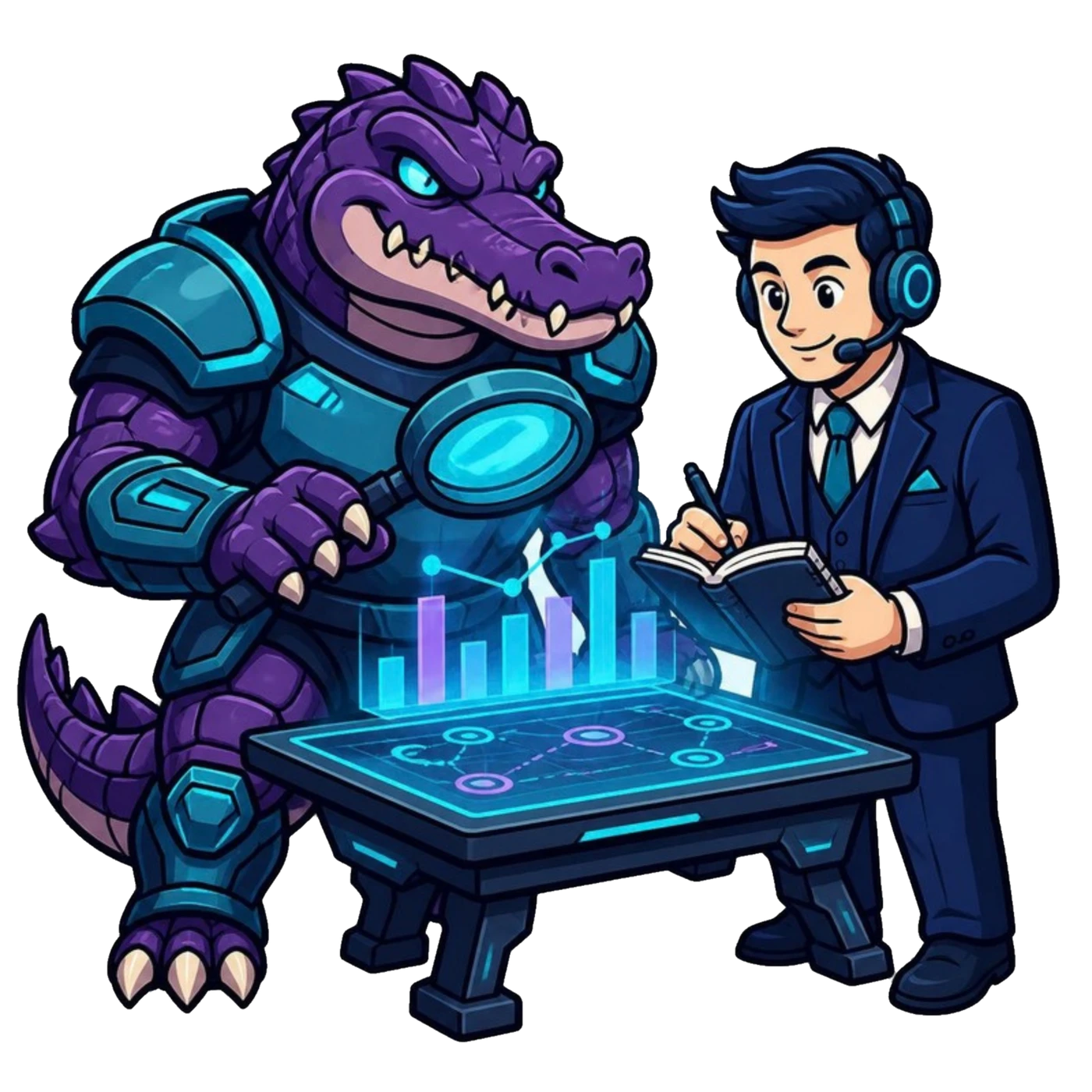
Deligatr is deliberately neither a fully automated tool nor a fully manual agency. A tool on its own runs on whatever it was given with nobody steering it. A fully manual team is careful but slower to react when a prospect does something. The hybrid model pairs the two: software for scale and timing, a team for strategy, copy and judgement.
The hybrid model
Who does what, job by job
Software handles scale and speed. People handle the decisions and everything written for your buyers.
- Strategy
Software does
Pulls live keyword, traffic and AI visibility data.
The team does
Chooses the ideal customer profile (ICP), the pillars, the channels and the order.
- Content
Software does
Applies schema, templates and linking rules consistently.
The team does
Writes and checks every page. No templated filler.
- Tracking
Software does
Identifies visitors and scores intent around the clock.
The team does
Decides which signals are worth acting on.
- Prospecting
Software does
Builds, enriches and verifies lists at scale.
The team does
Defines the profile and segments by industry.
- Outreach
Software does
Sends at the right moment on the right channel.
The team does
Writes copy for your sector and reviews every reply.
- Pipeline
Software does
Keeps one synced record per contact.
The team does
Reports plainly and adjusts the plan on the data.
The inbound side of this model is covered under SEO and AEO and GEO. The outbound side is under outbound. If you want to see the model sold as a service, read about the hybrid demand generation agency.
Quality gates: where a person checks the work
Nothing generated reaches a prospect or a published page without a human checkpoint first.
Gate 1
Every automated output has a human checkpoint before it reaches a prospect.
Gate 2
Generated call hooks are spot-checked on every batch before callers use them.
Gate 3
Uncertain data is flagged for review instead of guessed.
Gate 4
Every reply is read by a person.
Gate 5
Every claim on a page is checked before it ships.
The research behind these checks is described under research engine, and how messages are written and approved under personalisation.
How an engagement runs, stage by stage
An engagement has eight stages, from the first conversation to reporting and refining. Each stage is a milestone that triggers a notification on our side, so nothing sits unnoticed between stages.
- 1Before you sign
Consultation and audit
A conversation about what you want, alongside the AI Visibility and Conversion Audit.
- 2Before you sign
Proposal
The recommended direction (inbound, outbound or both) and what we build first.
- 3Sign
Sign and pay
One email with the contract and payment link. Nothing else to fill in yet.
- 4Onboarding
Book onboarding
Signing triggers an email and a text to book the onboarding call.
- 5Onboarding
Onboarding form
Once the call is booked, a short form: ICP, offers, proof, access and goals.
- 6Live in about one week
Setup
DeliHub and DeliChat connected, tracking configured, sending domains bought and set warming, keyword map and page plan finalised.
- 7Live in about one week
Launch
Content live, identification on, and outreach starting with warm contacts first.
- 8Ongoing
Report and refine
Plain-English reporting on what moved and what did not, re-measured regularly, with the plan adjusted on the data.
You are notified as each stage completes. For the managed outbound side of the work, the six-stage delivery process is on the how it works page.
What to expect, and when
For outbound, you are live in about one week. New sending domains then warm up for four to six weeks, and first meetings typically arrive in weeks four to six.
Outbound engagement
A typical outbound timeline, in weeks
Not a guarantee. Results depend on your market, your offer and what a customer is worth to you.
Setup to go-live
About one week
1 wkSending domains warm up
Four to six weeks
4 to 6 wksFirst outbound meetings
Typically weeks four to six
Wks 4 to 6Report and refine
Regular, plain-English
Ongoing →
Setup: ICP workshop (about one hour of your time), infrastructure build, copy written and approved. Inbound and AEO movement typically starts from about month 2 and builds from there. Nothing is guaranteed.
Design and conversion: from first visit to booked meeting
Getting found is half the job. Design and conversion decide whether a visit becomes a conversation, so we design the path and wire each step into the CRM.
The conversion path
Five steps from arrival to a logged conversation
Visibility without a conversion review is a bucket with a hole in it.
- 1
Arrive
From search, an AI answer or an email.
- 2
Understand
The answer sits at the top of the page.
- 3
Trust
Proof and named authors back it up.
- 4
Act
One clear step to take.
- 5
Logged
The visit and the action land in DeliHub.
The review checklist
What every page is checked against
- Page design in your brand, with clear hierarchy and mobile first.
- A short-answer block near the top: readers scan it and AI engines quote it.
- One primary action per page, not three competing asks.
- Forms of three fields at most, redirecting to a thank-you page so conversion can be measured.
- Repeatable page templates that carry schema, business details and the call-to-action hierarchy from the start.
- Lead magnets and diagnostics, free and ungated where the open version is what gets cited and shared.
- Every claim on the page checked, and any unsourced statistic sourced or removed.
- The same review on every new page, as visibility brings traffic to it.
Informational pages get a soft next step, and a visitor who is worried is not given a hard sell. The audit’s conversion score looks at these same signals, as explained on the audit page.
Tracking and measurement: what is wired up
If it cannot be measured it cannot be improved, so every engagement connects seven measurement layers.
Analytics
GA4 with defined conversion events: form submissions, bookings, diagnostic completions and key page visits.
AI referrals
A named channel group for traffic from ChatGPT, Perplexity, Gemini and Copilot.
Search
Google Search Console connected and monitored for impressions, position and clicks.
Booking
One booking system wired into the CRM, so every booked meeting lands on the right record.
Identification
DeliChat on every page, writing visits, scores and conversations into DeliHub.
Schema and site health
Structured data, sitemaps, redirects and internal links, maintained.
Automation
Webhooks and workflows that move a lead from a form, diagnostic or reply into the right pipeline stage and nurture sequence.