
Key takeaways
- Cold email is a one-to-one message to someone you have no relationship with, sent to start a business conversation. It becomes spam when it is untargeted, deceptive or impossible to opt out of. Infrastructure decides outcomes more than copy does.
- Fully authenticated domains (SPF, DKIM and DMARC together) were 2.7 times more likely to land in the inbox than unauthenticated ones in Saleshandy's analysis of 53.1 million cold emails (January to June 2026). Domain age barely mattered: in Warmup Inbox's 4,406-inbox study, a 6-12 month old domain placed at 99.06% against 98.41% for a domain over ten years old.
- Authentication is baseline, not optional. Google has enforced SPF, DKIM, DMARC and a spam-rate ceiling for bulk senders since February 2024, and Microsoft began rejecting non-compliant high-volume mail to Outlook.com on May 5, 2025.
- Measure replies, not opens. Litmus found Apple Mail accounts for 62.26% of tracked opens in a base of over a billion, and that Mail Privacy Protection affects roughly 55 to 60% of all opens. Belkins no longer reports open rates in its 2025 study.
- Benchmarks disagree because they measure different things. Belkins: 0.45% reply rate across 7.5 million emails, counted per email sent. Instantly: 3.43% platform average from its own users, with the top quartile above 5.5%. Both count replies per email sent, but the populations differ, so the two are not like for like.
Cold email is a one-to-one message sent to someone you have no prior relationship with, written to start a business conversation. It stops being cold email and becomes spam when it is sent to people with no reason to care, hides who it is from, or gives no way to opt out.
The line is both legal and practical. Legally, it is CAN-SPAM, GDPR, PECR and CASL, which we cover below. Practically, it is the complaint rate: if enough recipients mark you as spam, inbox providers stop delivering your mail regardless of the law. That second line is the one that ends most cold email programs, and it leads to the thesis of this guide: infrastructure decides the outcome more than copy does. A good message from a bad domain is never read. An average message from a well-built one gets a fair hearing. So the order here follows the order you should work in: infrastructure first, then the list, then the message, then the follow-up, then measurement.
The infrastructure layer: domains, mailboxes and why it comes first
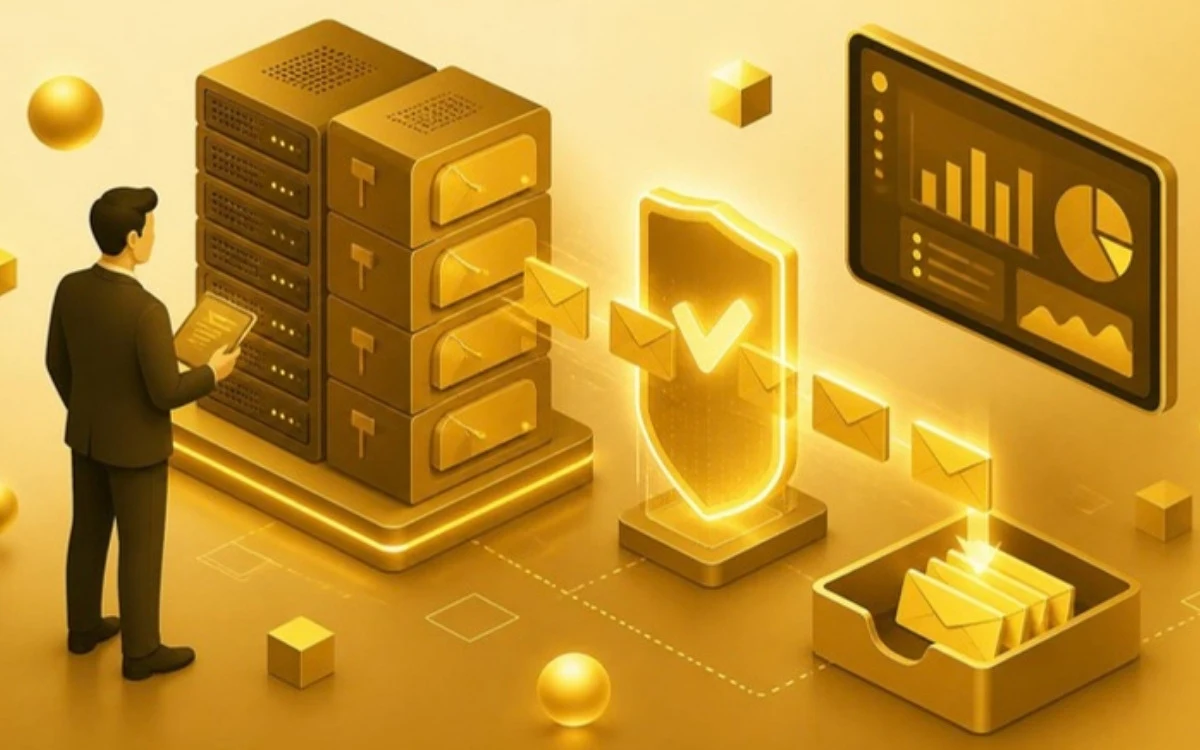
Cold email infrastructure is three things: the domains you send from, the mailboxes on those domains, and the DNS records that prove the mail is yours.
Use dedicated sending domains, never your primary one. Your primary domain carries your invoices, your client replies and your reputation. A spam complaint wave on a cold campaign should cost you a disposable domain, not the address your clients write to. A common pattern is a lookalike of your brand name, such as a variation of your company name, that redirects to your real site.
Do not pay a premium for an aged domain. A lot of advice treats domain age as a deliverability asset. Warmup Inbox tested it directly across 4,406 inboxes with validated registration dates over a 30-day placement window.
Domain age barely moves inbox placement once a domain is warmed
4,406 inboxes analyzed, inbox placement by domain age, 30-day window.
Warmup Inbox, 4,406-inbox placement study
The correlation between age and placement was -0.096, close to zero. Age is not a substitute for warming: a new domain that is properly warmed performs like an old one, and an old domain that is not warmed gets no protection from its age. We cover the full setup in the sections below.
Keep each mailbox's volume low. Google Workspace allows up to 2,000 messages per user per day, with a lower 1,500 limit for mail merge, and exceeding its limits suspends sending for up to 24 hours. That is a platform ceiling, not a target. Cold senders spread volume across many mailboxes so no single address or domain carries a suspicious load. AiSDR's published plans, for what it is worth, scale as multiples of three mailboxes per domain: 1 domain with 3 mailboxes on its Solo plan, 2 domains with 6 on Explore, and 6 domains with 18 on Scale.
How many domains do you need?
Work backward from the volume you want to send.
Planning example: mailboxes and domains for 1,000 emails a day
The per-mailbox cap and mailboxes per domain are conservative planning assumptions, not rules. Adjust to your own ramp and results.
| Step | Calculation | Result |
|---|---|---|
| Target volume | Emails you want to send per day. | 1,000 a day |
| Per-mailbox cap | Assume 30 sends per mailbox per day, the top of the ramp in weeks three and four. | 30 a day |
| Mailboxes needed | 1,000 divided by 30, rounded up. | 34 mailboxes |
| Mailboxes per domain | Assume 3 per domain, in line with AiSDR's published plan structure. | 3 per domain |
| Domains needed | 34 divided by 3, rounded up. | 12 domains |
Planning arithmetic by Deligatr. Google Workspace limits: Google, Gmail sending limits in Google Workspace.
That is a lot of infrastructure for 1,000 emails a day, which is the point. The sheer number is why most small senders either run far lower volumes on well-targeted lists or use a managed platform. It is also a reminder that volume is a cost you pay in domains, mailboxes and monitoring, not a free dial.
SPF, DKIM, DMARC and one-click unsubscribe
Three DNS records tell inbox providers your mail is authorized. SPF lists the servers allowed to send for your domain. DKIM adds a cryptographic signature proving the message was not altered. DMARC tells receivers what to do when SPF or DKIM fails and gives you reports. None of this is new, but the major providers have turned it from advice into enforcement.
What the big inbox providers require from high-volume senders
The formal thresholds apply to senders of 5,000 or more emails a day to the provider's consumer addresses.
| Provider | Requirements | Enforcement |
|---|---|---|
| Google (Gmail) | SPF, DKIM and a published DMARC record; one-click unsubscribe on marketing mail; spam rate kept under 0.3%, with 0.1% recommended. | In force since February 2024. Escalated in November 2025 from delivery delays to permanent rejection of non-compliant mail. |
| Microsoft (Outlook.com, Hotmail, Live) | SPF and DKIM must pass, and DMARC at minimum p=none aligned with SPF or DKIM. | Applied from May 5, 2025. Non-compliant mail is rejected with a 550 error. |
| Yahoo | Equivalent requirements to Google, without a published volume threshold. | In force since 2024. |
Google Workspace, Email sender guidelines; Microsoft Outlook high-volume sender requirements (April 2025 announcement, as summarized by dmarcian); Deligatr deliverability analysis.
Two honest notes. First, most cold senders sit below 5,000 emails a day to any one provider, so the formal bulk-sender rules may not strictly bind you. Authentication is still the baseline reputation signal every provider checks, so configure it on every sending domain regardless. Second, one-click unsubscribe is a bulk-marketing requirement, but a visible, honored opt-out in every cold email is both good practice and the cleanest way to keep complaints down. People who cannot find an unsubscribe link click "report spam" instead, and that is the signal that does the damage.
The volume ramp: week one versus week eight
A new domain that sends hundreds of emails on day one looks exactly like spam. Warming is the process of building a sending history gradually, and the evidence on how long it takes is consistent: Microsoft's own guidance puts it at four to eight weeks, and four to six weeks is what we use in practice. In Saleshandy's analysis of 53.1 million cold emails, a warmed, authenticated domain reached 87% inbox placement against 12% for an unwarmed domain.
A volume ramp for each new mailbox
Per mailbox. Check bounce rate and spam complaints at every step, not at the end.
| Weeks | Emails per mailbox per day | Send to | Watch |
|---|---|---|---|
| 1 to 2 | 5 to 10 | Contacts likely to engage and reply, not a cold list. | Reply and open signals building. |
| 3 to 4 | 20 to 30 | A gradual widening of your verified list. | Bounce rate under 2%. |
| 5 to 6 | Up to your target volume | Your real target list, in stages. | Spam complaints under 0.1%. |
| 7 onward | Hold steady | Continue to verify before every send. | Any rise in bounces or complaints, immediately. |
Warming schedule from Deligatr's deliverability guide; bounce and complaint thresholds are our working limits; four-to-eight-week range from Microsoft's guidance.
A sudden spike in sending velocity is one of the clearest signals providers watch for, so ramp slowly even on a domain that has already been warmed. The 2% bounce and 0.1% complaint thresholds are tighter than Google's 0.3% ceiling on purpose: by the time you are near Google's limit, you are already in trouble.
List building: sourcing, verification and the cost of a bad list
Infrastructure gets you into the inbox. The list decides who is there.
Sourcing. Lists come from data providers, professional networks, public registries and your own research. Whichever you use, the discipline is the same: define the buyer in two sentences first, then build the list to match, not the other way around. The tighter the targeting, the lower the complaint rate and the higher the reply rate.
Targeting matters more than most people expect. In Belkins' analysis of 7.5 million cold emails, reply rate varied sharply by who was on the other end.
Cold email reply rate by company size
Replies divided by emails sent. Belkins, 7.5 million emails, 2025.
Belkins, B2B Cold Email Response Rates (7.5 million emails, 2025)
By seniority, founders and owners replied at 0.57%, C-level executives at 0.42% and VPs at 0.32%. Smaller companies and the people who own them reply more.
Verification. Every address should be verified before sending, because bounces damage the reputation you just spent weeks building. Keep the bounce rate under 2%. List decay is real but poorly measured: estimates for how fast business email data goes stale start around 22.5% a year (a figure attributed to HubSpot Benchmarks in ZoomInfo's analysis) and run much higher in other vendors' analyses, but none of them traces to a study we could verify, so do not rely on a single number. Verify before every send, not once per list.
The cost of a bad list shows up downstream. In Belkins' cold calling data, 26.9% of non-meeting outcomes were the wrong person or a gatekeeper, which is a list problem, not a script problem. We covered that dataset in our cold calling analysis. The same logic applies to email: a message to the wrong person is wasted no matter how well it is written.
The message: a four-part structure that does not read as AI
Most cold emails fail in the first sentence. They open with a compliment, an introduction of the sender, or a hope that the recipient is well, and the reader has already stopped. A structure that holds up is four short parts.
- The reason. Why you, to them, now. A real trigger: a hire, a funding round, a post, a launch, a job opening.
- The relevance. One sentence connecting that trigger to a problem they likely have.
- The proof or offer. One sentence on how you solve it, specific enough that it could not apply to any company in any industry.
- The ask. A small, easy next step, phrased as a question.
Example, first email
The four-part structure in practice
Subject: your new head of sales hire

Hi [First Name],

Saw [Company] just hired a head of sales. [The reason.]

When outbound scales after a hire like that, sending infrastructure is usually the first thing to strain. [The relevance.]

We set up the domains, authentication and warm-up so your new hire's first campaign lands in inboxes instead of spam. [The proof or offer.]

Worth a 15-minute call to see if it's relevant? [The ask.]

[Your name]
Why this works: Four sentences, about 65 words. The subject line names a real trigger rather than a generic hook, which is the specific kind of personalization the data supports. Swap in your own trigger and offer, and keep every sentence specific to the recipient.
Keep it short. Instantly's 2026 benchmark, drawn from billions of cold email interactions across thousands of workspaces, found elite performers average fewer than 80 words in the first email. That is a correlation from one platform's data, not a controlled test. It matches the job a cold email has: earn a reply, not close a deal.
Subject lines matter, with a caveat about the data. Belkins analyzed 5.5 million emails sent across 2024 and found personalized subject lines drew a 46% open rate against 35% for generic ones, and a 7% reply rate against 3%. Opens are unreliable now (see the measurement section), and that study predates Belkins' stricter reply-per-email-sent method, so the open figures should be read cautiously. The reply gap is the part worth keeping. The annotated templates guide has full three-touch sequences built around this data.
What reads as AI, and why it hurts. Generic flattery, stacks of adjectives, an over-polished first line, and a "personalized" sentence that could have been written about anyone. The best-sampled evidence we found is on LinkedIn, where Expandi's analysis of 13.2 million connection requests found AI hyperpersonalization lowered acceptance rate by 12% and left reply rate flat. It is a different channel, but the lesson transfers: personalization that sounds specific without being specific does not work.
Personalization that is worth the compute, and the kind that is not
Not all personalization is equal, and the cost of doing it varies enormously. Think in three tiers.
- Segment-level, cheap and always worth it. The message is written for a specific type of company or role, not for everyone. This is mostly a targeting decision and costs almost nothing per email.
- Account-level, worth it for a real trigger. A fact about the company that justifies reaching out now. This is where signal-based outreach earns its place.
- Person-level, worth it only for your top accounts. A reference to something the individual wrote or said. It is expensive to do well and obvious when done badly.
The same Expandi data found requests that referenced something specific and real, a shared group, a recent post or a mutual connection, ran 1.8 to 2.7 times the 30.2% baseline acceptance rate. Real specificity pays. Decorative specificity does not. A rule that holds across channels: personalize the reason you are writing, not the flattery.
Follow-up: how many, how far apart, and when to stop
Follow-ups are where a meaningful share of the replies are. Instantly's 2026 benchmark found 58% of all replies come from the first email and 42% from follow-ups, which means stopping after one email leaves nearly half the available replies uncollected. It puts the sweet spot at four to seven touchpoints and warns that returns diminish beyond seven unless each touch adds genuine new value.
Our practical range is three to five emails, spaced across roughly two weeks, with each follow-up adding something the previous one did not: a relevant stat, a short example, a different angle. A bump that only repeats the ask reads as pressure. The end of the sequence should give a clean, low-pressure way out, which is also what keeps complaints down. Our templates guide shows an opener, a bump and a breakup in full.
Stop rules matter as much as the sequence. Stop on any reply, on an unsubscribe, and on a bounce. Pause a campaign if spam complaints or bounces rise. A sequence that keeps emailing someone who has opted out is the quickest route to a complaint and a legal problem.
Measurement: reply rate, not open rate, and why
For years the default cold email dashboard led with open rate. It no longer tells you what it appears to.
62.26%
of tracked email opens come from Apple Mail, in a base of over a billion opens
Litmus, Email Client Market Share, July 2026
Litmus reports that Apple's Mail Privacy Protection now affects roughly 55 to 60% of all email opens. MPP pre-loads tracking pixels at delivery, so an "open" can be recorded whether or not anyone read the message. Belkins moved to the same approach in its 2025 study: it no longer reports open rates and measures replies divided by total emails sent instead.
Measure instead:
- Reply rate, as replies divided by emails sent, so it is comparable over time.
- Positive reply rate, the share of replies that show interest, which separates real response from unsubscribes and out-of-office messages.
- Meetings booked per 1,000 emails sent. Belkins booked over 1,200 appointments across 7.5 million emails, which is roughly 0.16 per 1,000 emails, or about one appointment per 6,250 emails or fewer (our arithmetic). At three emails per contact, that is about 2,083 contacts per appointment at the average, which is why targeting and list quality matter so much.
- Bounce rate and spam complaints, the health indicators that protect everything else.
- Held meetings and opportunities, which separate real pipeline from replies. Our B2B lead generation guide lays out the full chain of six numbers.
Now the confusing part: published reply-rate benchmarks disagree by almost an order of magnitude, because they measure different things.
Two cold email benchmarks and what each actually measures
Neither is wrong. They describe different populations, so they are not like for like.
| Belkins | Instantly | |
|---|---|---|
| Sample | 7.5 million emails, calendar year 2025, Belkins client campaigns. | Billions of interactions across thousands of workspaces, January 1 to December 18, 2025. |
| Average reply rate | 0.45% | 3.43% |
| Denominator | Replies divided by total emails sent. | Replies divided by total emails sent, including follow-up replies. |
| Top performers | Not published as a tier. Best segments: 0.72% for 0-10 employee companies. | Top quartile 5.5% or more; elite tier above 10%. |
| Population | Campaigns Belkins runs and tracks. | Users of one sending platform, a self-selected group. |
Belkins, B2B Cold Email Response Rates (2025); Instantly, Cold Email Benchmark Report 2026.
The honest takeaway is to benchmark yourself against your own history first, and to treat any platform average as coming from its own self-selected users. A 3% reply rate in one population can be a weaker result than 0.5% in another.
Compliance: CAN-SPAM, GDPR, PECR and CASL in one view
Compliance varies by where the recipient is, not where you are. Our full compliance guide covers each regime. This is the summary.
Cold email law at a glance: B2B
A summary, not legal advice. Check the rules for the countries your list actually sits in.
| Region | B2B cold email | Key rule and penalty |
|---|---|---|
| United States (CAN-SPAM) | Allowed without prior consent. | Honest headers and subject lines, a physical address and a working opt-out. Maximum civil penalty of $53,088 per non-compliant email, and each recipient counts separately. |
| European Union (GDPR) | Allowed in most countries under legitimate interest. | You need a documented legitimate-interest basis and a clear opt-out. Germany generally requires consent, even for B2B. |
| United Kingdom (PECR and UK GDPR) | Allowed to corporate bodies without consent. | Sole traders and some partnerships count as individuals and need consent. A named person's work address can still trigger UK GDPR obligations. |
| Canada (CASL) | No general B2B prospecting exemption. | Needs express or valid implied consent. Implied consent expires, at 2 years after a purchase and 6 months after an inquiry. Penalties reach $1 million for individuals and $10 million for corporations. |
FTC CAN-SPAM guide; UK ICO electronic mail marketing guidance; CRTC and Government of Canada, as summarized in Deligatr's compliance guide.
The practical rule that covers all of them: build the opt-out once and apply it everywhere, keep a record of why each list exists, and segment Canadian contacts separately.
Where DeliMail fits
We build and sell DeliMail, $199 a month on its own or $499 a month bundled with DeliChat and DeliReach, a managed cold email platform with dedicated sending domains separate from your main email, domain warm-up, SPF, DKIM and DMARC configuration, and deliverability monitoring, so weigh this section accordingly. It exists because the steps above are laborious and unforgiving: the infrastructure has to be right before the first email goes out, and nobody enjoys maintaining twelve domains.
If you would rather hand off the whole operation, our done-for-you outbound service runs the infrastructure, the list, the sequences and the booking. If you want to run it yourself, the checklist above is everything we would do.
Book a consultation and we will audit your sending setup, your list and your current reply data before recommending anything.
Book a ConsultationSources
- Google Workspace, Email sender guidelines, bulk sender requirements effective February 2024
- Google Workspace, Gmail sending limits in Google Workspace
- Microsoft Defender for Office 365 blog, Outlook's new requirements for high-volume senders, April 2025, as summarized by dmarcian
- Belkins, B2B Cold Email Response Rates, 7.5 million emails, 2025
- Belkins, B2B Cold Email Subject Line Statistics, 5.5 million emails, 2024
- Instantly, Cold Email Benchmark Report 2026, billions of interactions, January to December 18, 2025
- Saleshandy, Email Deliverability Statistics, 53.1 million emails
- Warmup Inbox, What Actually Drives Inbox Placement, 4,406 inboxes
- Litmus, Email Client Market Share, July 2026, over one billion tracked opens
- Expandi, State of LinkedIn Outreach H2, 13.2 million connection requests
- AiSDR, Pricing, for published plan infrastructure structure
- ZoomInfo, B2B Data Decay, for the attribution of the 22.5% figure to HubSpot Benchmarks
- FTC, CAN-SPAM Act: A Compliance Guide for Business; UK ICO, Electronic mail marketing; CRTC, Compu-Finder notice of violation
FAQ
Is cold email legal?
In the US and most of the EU, yes for B2B, with rules attached. CAN-SPAM requires honest headers and subject lines, a physical address and a working opt-out, with civil penalties of up to $53,088 per non-compliant email. GDPR's legitimate interest basis permits B2B cold email across most of the EU, with Germany generally requiring consent. Canada is the exception: CASL has no general B2B prospecting exemption. This is a summary, not legal advice, so check the rules for the countries your list actually sits in.
Is cold email legal in the UK under GDPR?
Generally yes for corporate recipients. The ICO's guidance under PECR allows marketing emails to corporate bodies without prior consent, but sole traders and some partnerships count as individuals and need consent, and a named person's work address can still bring UK GDPR obligations into play. Always identify yourself, include a working opt-out and honor it.
How many cold emails can I send per mailbox per day?
The platform ceiling is not the practical limit. Google Workspace allows up to 2,000 messages per user per day, and exceeding its limits can suspend sending for up to 24 hours, but cold senders operate at a small fraction of that. Our ramp starts at 5 to 10 a day per mailbox, reaches 20 to 30 a day by weeks three and four, and scales only while bounce rate stays under 2% and spam complaints under 0.1%. Treat the ramp, not the ceiling, as your cap.
How many domains do I need?
Enough that no single mailbox or domain carries more than a modest share of your volume. As a planning rule, divide your target daily volume by the per-mailbox cap to get mailboxes, then by the number of mailboxes per domain to get domains. At 1,000 emails a day, 30 per mailbox and 3 mailboxes per domain, that is about 34 mailboxes across 12 domains. The 30 and the 3 are conservative planning assumptions, not rules. Never send cold email from your primary business domain.
Why do my cold emails go to spam?
Mostly because of the sending domain's authentication and history, not the wording. In Saleshandy’s analysis of 53.1 million cold emails (January to June 2026), fully authenticated domains (SPF, DKIM and DMARC together) were 2.7 times more likely to land in the inbox than unauthenticated ones. Fix SPF, DKIM and DMARC, warm the domain for four to six weeks, verify the list, and keep bounces under 2% and spam complaints under 0.1%.
What is a good cold email reply rate?
It depends on how the rate is measured, which is why published benchmarks disagree. Belkins found 0.45% across 7.5 million emails in 2025, measured as replies divided by emails sent. Instantly reports a 3.43% average across billions of interactions on its platform, with the top quartile at 5.5% or more and the top tenth above 10%. Instantly defines its rate as replies divided by total emails sent, but it is a platform average from its own users’ campaigns, a self-selected population that is not like for like with Belkins’ 0.45% across 7.5 million emails. Compare your own rate to a benchmark with that in mind.
How long should a cold email be?
Short. Instantly's 2026 benchmark found elite performers average fewer than 80 words in the first email. That is a correlation from one platform's data, not a controlled test, but it matches the logic of the format: a cold email has one job, which is to earn a reply, and every extra sentence is another reason not to give one.
How many follow-ups should a cold email sequence have?
Three to five touches total is a sound starting range. Instantly found 58% of replies come from the first email and 42% from follow-ups, and it puts the sweet spot at four to seven touchpoints, warning that returns diminish beyond seven unless each touch adds something new. Whatever the count, each follow-up has to add information, and the sequence should stop on any reply, unsubscribe or bounce.